Content and Marketing: How They Work Together to Grow a Business
Published: 22 Oct 2026
Content and marketing are two essential elements of business growth. Content provides the information, ideas, stories, and resources that help customers understand a brand, while marketing makes sure those messages reach the right people at the right time. When businesses combine both effectively, they can increase brand awareness, attract qualified visitors, build trust, generate leads, and turn potential customers into loyal buyers.

However, creating content without a marketing plan often leads to limited visibility, while marketing without useful content can struggle to earn customer attention. Businesses need both to communicate their value, solve customer problems, and encourage meaningful action. Understanding the fundamentals of digital marketing helps businesses see how content, SEO, social media, and email campaigns can support a common objective.
Understanding how content and marketing work together helps business owners make better decisions about blogging, search engine optimization (SEO), social media, email campaigns, advertising, and customer communication. Instead of treating these activities as separate tasks, companies can connect them through a unified plan that supports measurable business objectives.
What Are Content and Marketing?
Content refers to the information and creative material a business produces to communicate with its audience. It includes blog articles, website pages, videos, podcasts, infographics, email newsletters, case studies, product guides, social media posts, and downloadable resources. Good content answers questions, explains complicated topics, solves problems, or helps customers make informed decisions.
Marketing is the broader process of understanding customer needs, communicating a product or service’s value, reaching potential buyers, and encouraging profitable customer relationships. It includes audience research, positioning, pricing, promotion, distribution, customer engagement, and performance measurement. A well-defined marketing strategy connects these activities with business goals and customer needs.
Although these concepts have different roles, they depend on each other. Content gives marketing something valuable to communicate, while marketing provides the strategy and distribution needed to make that content effective.
For example, a small accounting firm might publish an article explaining how freelancers can organize their business expenses. Search engine optimization helps the article appear when relevant users search for financial guidance. Social media introduces the resource to a wider audience, while an email newsletter shares it with existing subscribers. A relevant call to action can then invite readers to schedule a consultation.
In this example, the article is the content, but the coordinated activities that help the right audience discover and use it form part of the marketing process. The business benefits because each activity supports the same objective.
Businesses that want a broader understanding of these activities can also explore the fundamentals of digital marketing, which explain how different online channels contribute to customer acquisition and business growth.
Why Content and Marketing Work Better Together
Content and marketing are most effective when they share the same goals, audience insights, and messaging. Content creators need to understand what the business wants to achieve, while marketers need relevant material that communicates the brand’s value. For a broader explanation of the subject, the Content Marketing Institute’s guide to content marketing explains the role of valuable, audience-focused content in marketing.
One important benefit is improved brand awareness. Potential customers cannot consider a business they have never discovered. Useful articles, social media updates, videos, and search-focused website pages introduce the company to people who may need its products or services.
Furthermore, consistent and informative communication can build credibility. When a business regularly answers customer questions and explains industry topics accurately, it gives people reasons to return. Although publishing content does not automatically establish trust, demonstrating genuine expertise and maintaining consistent quality can strengthen a brand’s reputation over time.
Another benefit is more efficient customer acquisition. A single research-based article can attract organic visitors, support social media posts, provide material for an email campaign, and help sales teams answer common questions. Rather than creating unrelated messages for every channel, businesses can adapt useful content to different customer needs.
Content also supports customer education. Some buyers need basic information before understanding a product, while others require comparisons, demonstrations, pricing details, or proof that a solution works. Matching content to these different needs can make the buying process easier.
Finally, combining content with marketing improves measurement. Businesses can evaluate whether their content attracts relevant visitors, generates inquiries, assists conversions, or encourages repeat purchases. These insights help teams invest in activities that contribute to meaningful results rather than focusing exclusively on publishing volume.
How Content and Marketing Work Together Across the Customer Journey
Awareness stage: At this stage, potential customers may not know your brand or understand the available solutions. Educational blog posts, short videos, social media content, and informative infographics can introduce the topic without immediately pushing a sale. Businesses can improve their website content by following Google’s SEO Starter Guide.
Content and marketing can support each stage by providing relevant information and an appropriate next step.
Awareness stage: At this stage, potential customers may not know your brand or understand the available solutions. Educational blog posts, short videos, social media content, and informative infographics can introduce the topic without immediately pushing a sale. Search engine optimization and relevant distribution channels help these resources reach interested audiences.
Consideration stage: Once people understand their problem, they often compare different approaches. Detailed guides, comparison articles, webinars, product explainers, and practical case studies can help them evaluate alternatives. Marketing channels such as email newsletters and targeted campaigns can deliver these resources to people who have expressed interest.
Decision stage: Potential buyers now need enough information to choose a provider or product. Customer testimonials, demonstrations, transparent pricing information, detailed product pages, and relevant case studies can address remaining concerns. Clear calls to action make it easier to request a quote, arrange a demonstration, or complete a purchase.
Retention stage: The relationship should not end after the first sale. Helpful onboarding emails, troubleshooting guides, tutorials, product updates, and customer support resources can help people use their purchase successfully. Satisfied customers may return, renew a service, or recommend the business to others.
The important point is that each piece of content should serve a purpose. A beginner’s guide may introduce a brand to new audiences, whereas a product comparison may help an interested visitor make a decision. Matching the material to the customer’s needs creates a more coherent experience.
Types of Content That Support Marketing Goals
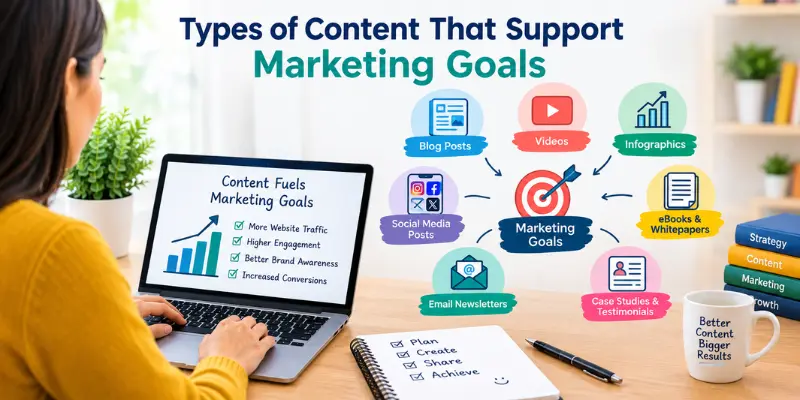
Businesses can use several content formats, but the right selection depends on the audience, available resources, industry, and marketing objectives.
Blog posts and educational articles: Articles answer questions, explain concepts, and help businesses attract people through organic search. They can also provide material for newsletters, social media updates, and sales conversations. Businesses planning a broader channel mix can explore types of digital marketing to understand how content works alongside other promotional activities.
Website pages and landing pages: Website content explains what a business offers, whom it serves, and why potential customers should consider its products or services. Landing pages focus on a particular campaign or action, such as requesting a consultation or downloading a guide. Both should use clear language and relevant calls to action.
Videos and demonstrations: Videos can make complex subjects easier to understand. Product demonstrations, tutorials, expert explanations, and customer stories help audiences see how a solution works. Businesses should select video formats that match their resources and the platforms their audiences actually use.
Social media content: Social media helps companies distribute useful information, participate in conversations, share updates, and build relationships. A detailed article can be adapted into short tips, a carousel, a short video, or a discussion question. Each version should fit the platform instead of simply copying the original material.
Email newsletters: Email allows businesses to communicate directly with subscribers who have chosen to receive their messages. Newsletters can share new articles, educational resources, relevant offers, and product updates. Segmentation helps make messages more relevant to subscribers’ interests and stage in the customer journey.
Case studies and customer stories: These resources demonstrate how a business addresses a real problem. With appropriate customer permission and accurate reporting, a case study can explain the situation, the solution, the implementation process, and the results achieved. Such evidence can help prospective customers evaluate whether a service suits their needs.
Guides, templates, and webinars: More detailed resources can help audiences understand a complicated subject or complete a specific task. A downloadable template, for example, may provide immediate practical value, while a webinar can allow participants to learn from experts and ask questions.
Businesses do not need to use every format. Instead, they should select a manageable combination that serves their audience and supports their goals.
How to Build a Content and Marketing Strategy
An effective strategy connects business objectives with customer needs, content planning, distribution, and performance measurement. The following process provides a practical starting point.
1. Define your business goals. Begin by deciding what the business needs to achieve. Possible objectives include increasing qualified website traffic, generating sales inquiries, promoting a new service, improving customer retention, or increasing repeat purchases. Goals should be specific enough to guide decisions and evaluate progress.
For instance, a consulting firm might aim to increase qualified consultation requests from organic website visitors over the next quarter. This objective provides a clearer direction than a general goal of publishing more articles.
2. Understand your target audience. Identify the people most likely to benefit from your products or services. Research their needs, concerns, budgets, preferences, and decision-making processes. Customer interviews, surveys, sales conversations, support questions, reviews, and search queries can provide useful insights.
Next, distinguish between different audience groups. A first-time buyer may need basic educational content, whereas an experienced decision-maker may want detailed comparisons, implementation guidance, or evidence of return on investment. The more accurately your content reflects these needs, the more relevant your marketing becomes.
3. Research keywords and customer questions. Search engine optimization can help you discover what potential customers want to know. Keyword research tools, search suggestions, competitor analysis, and customer questions can reveal relevant topics. Google Search Console can help website owners monitor search performance and understand which queries bring visitors to their pages.

Choose a primary topic for each article and identify closely related questions that belong within it. Review the existing content on your website before creating another page, because multiple articles targeting the same intent can compete with one another.
For additional guidance, consult Google’s SEO Starter Guide. It provides official recommendations for making website content easier for search engines to discover and understand.
4. Develop a content plan. Create a publishing calendar that connects each content item to a business goal. Record its topic, target audience, intended search intent, format, publication date, distribution channels, and performance indicators.
Plan a useful mix of awareness, consideration, decision, and retention content. This prevents the business from publishing only introductory articles while neglecting resources that help customers evaluate products or take the next step.
5. Create valuable, original content. Research the subject carefully, organize the information logically, and explain concepts in language the intended audience understands. Include practical examples, relevant evidence, and original insights wherever possible.
Avoid publishing generic content solely to increase page count. Before approving a piece, ask whether it answers the reader’s question, provides something useful, and accurately represents the business. Fact-check important claims and review links before publication.
6. Optimize and publish strategically. Make the content easy to read, navigate, and use. Write a descriptive title, use relevant headings, add suitable images when helpful, and include internal links to related resources. Pages should also work well on mobile devices and load efficiently. Linking to a relevant marketing strategy guide can help readers explore business planning in more detail.
7. Distribute content through suitable channels. Publishing does not guarantee that the intended audience will discover a resource. Consider organic search, email, social media, partnerships, communities, and paid promotion according to your goals and budget.
A small business might begin with SEO and a newsletter rather than trying to maintain a presence on every social platform. The aim is to reach relevant people consistently, not to maximize the number of channels used.
8. Measure results and improve. Review performance after publication and allow sufficient time for meaningful patterns to emerge. Identify which content attracts relevant visitors, generates inquiries, assists conversions, or supports retention.
Use these findings to improve headlines, clarify explanations, update outdated information, strengthen calls to action, and develop follow-up content. Over time, this process helps the business make better decisions about its content and marketing investments.
The Role of SEO in Content and Marketing
Search engine optimization connects useful website content with people who are actively looking for information, products, or services. It can support long-term discoverability by helping search engines understand a page and making the page more useful to its intended audience. Google’s SEO documentation provides further guidance on search visibility and website optimization.
Keyword research is one part of SEO, but it should not control every editorial decision. Search intent, topic relevance, content quality, website usability, and internal linking also matter. Repeating a keyword excessively does not guarantee rankings and can make an article difficult to read.
For example, a company selling project management software could publish a guide about organizing remote teams. The article might answer common questions, include practical workflows, and link to a relevant product page. Visitors who find the guide through search can explore the product when they are ready, provided the page makes that next step relevant and easy.
Businesses should also monitor search impressions, clicks, click-through rates, and relevant landing-page activity. Google Search Console provides information about a website’s performance in Google Search, while analytics tools can help evaluate subsequent website interactions.
For businesses expanding their digital presence, the guide to types of digital marketing explains how search, social media, email, and other channels can complement one another.
How Social Media and Email Amplify Content
Social media and email can extend the reach of content beyond the people who discover it through search. However, each channel serves a different purpose and requires an appropriate approach. Businesses should align these activities with their overall digital marketing strategy rather than treating every channel as a separate effort.
Social media is useful for distributing short, engaging messages, participating in conversations, sharing customer stories, and directing interested people to more detailed resources. Businesses should choose platforms based on audience behavior and business objectives rather than popularity alone.
Email is particularly useful for maintaining communication with people who have subscribed to receive updates. A business can share new articles, helpful advice, relevant product information, and occasional offers. Segmentation and personalization can improve relevance, while clear unsubscribe options and responsible list management help maintain trust.
Repurposing content makes these activities more efficient. A single detailed article could become a short email, several social posts, a brief video script, and a downloadable checklist. Nevertheless, each version should be adapted to its audience and channel.
When these channels work together, content has more opportunities to reach people at different stages of the customer journey. The business can also learn which topics attract attention and which messages encourage useful engagement.
Measuring the Results of Content and Marketing
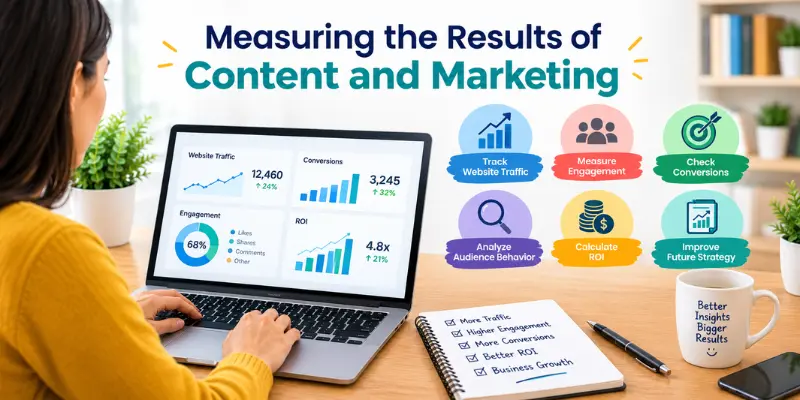
Businesses need suitable performance indicators to understand whether their efforts are producing meaningful results. The right metrics depend on the purpose of the campaign. Tools such as Google Analytics can help businesses understand website activity and evaluate how visitors interact with important pages.
Reach and awareness: Website impressions, relevant organic visits, branded search activity, and audience reach can indicate whether more people are discovering the business. These measures show visibility, but they do not prove that awareness is producing sales.
Engagement: Email clicks, meaningful social interactions, returning visitors, and engagement with important website pages can provide clues about audience interest. Interpret these measures in context because a high engagement rate does not necessarily indicate strong purchase intent.
Lead generation: Track qualified inquiries, consultation requests, form submissions, webinar registrations, and relevant downloads. Where possible, distinguish genuine prospects from low-quality submissions or unrelated traffic.
Conversions and revenue: Measure purchases, completed bookings, customer acquisition cost, and revenue associated with campaigns where reliable tracking is available. Businesses with longer sales cycles may also need to examine assisted conversions and the influence of content across several customer interactions.
Retention: Repeat purchases, renewals, customer referrals, and engagement with onboarding resources can help reveal whether content supports existing customers.
For example, suppose a business publishes an educational article that attracts 2,000 visitors but generates few inquiries. The next step is not automatically to abandon the article. The team should investigate whether the visitors match the intended audience, whether the article satisfies their search intent, and whether the next step is clear and relevant.
A smaller article attracting 300 highly relevant visitors and generating several qualified inquiries may contribute more directly to business objectives. The lesson is to evaluate quality and outcomes alongside traffic.
Common Mistakes to Avoid
One common mistake is creating content without a defined objective. Publishing regularly can be helpful, but every piece should serve a purpose for the audience and the business. A content calendar should support strategy rather than become a checklist of unrelated topics.
Another mistake is focusing exclusively on promotion. Paid advertising and social distribution may increase exposure, but they cannot compensate indefinitely for content that is inaccurate, unhelpful, or poorly matched to customer needs.
Businesses can also waste resources by targeting every channel at once. Maintaining multiple social profiles, newsletters, blogs, and video channels requires time and coordination. It is often better to establish a sustainable process with a few appropriate channels before expanding.
Ignoring performance data is another problem. Teams that never review results may continue investing in content that attracts irrelevant visitors or fails to support their objectives. Measurement should inform decisions, but changes should be based on sufficient evidence rather than isolated fluctuations.
Finally, businesses should avoid excessive keyword repetition, unsupported claims, copied material, and misleading calls to action. Accurate information, original insights, transparent communication, and a useful customer experience provide a stronger foundation for long-term growth.
A Practical Example of Content and Marketing Working Together
Consider a small business that sells eco-friendly cleaning products. Its objective is to increase online sales while helping customers understand the benefits and appropriate use of its products.
The business begins by researching customer concerns, such as choosing suitable ingredients, understanding product labels, and selecting products for different surfaces. It then publishes educational articles addressing those questions and optimizes them for relevant search queries.
Next, the company adapts the most useful information into short social media videos and an email newsletter. The newsletter offers subscribers practical cleaning advice and links to relevant product pages. Product descriptions explain intended uses, instructions, and important limitations clearly.
The company then measures organic visits, email clicks, product-page activity, completed purchases, and customer feedback. If a particular topic attracts relevant visitors but produces few product interactions, the team reviews the page’s usefulness and the relevance of its links.
Over time, the business can improve its content plan using observed customer questions and performance data. The process connects educational content with discovery, product consideration, purchasing, and customer support.
This example illustrates a broader principle: effective content and marketing are not simply about producing more messages. They involve coordinating useful information with the right audience, channel, timing, and business objective.
How Small Businesses Can Get Started on a Limited Budget
Small businesses do not need a large marketing department to begin connecting content with marketing. They can start with a focused plan based on their existing knowledge, customer questions, and available resources. Free tools such as Google Search Console can help them monitor organic search performance as they improve their content.
First, choose one clear objective and one priority audience. Next, identify a small group of questions that audience frequently asks. Create a useful website resource addressing the most important question, then link it to relevant existing pages and provide a clear next step.
After publishing, share the resource through one or two suitable channels. For example, a local service business could distribute an educational article through its email newsletter and social media accounts while gradually improving its search visibility.
Use free or accessible tools where appropriate. Google Search Console can help monitor search performance, while website analytics can provide insight into user interactions. A spreadsheet can organize the publishing calendar and record important metrics.
Consistency matters, but consistency should be sustainable. Publishing one genuinely useful resource and promoting it effectively may be more practical than creating several weak articles every week.
As the business learns which topics and channels perform well, it can expand the plan. Additional investment should follow demonstrated needs and opportunities rather than assumptions about which marketing trend is most popular.
Frequently Asked Questions
What is the difference between content and marketing?
Content is the information or creative material a business produces, such as articles, videos, emails, and guides. Marketing is the broader process of understanding customers, communicating value, distributing messages, and encouraging customer relationships. Content can support many marketing activities, but marketing also includes elements such as positioning, pricing, promotion, and research.
How do content and marketing help a business grow?
They work together to help potential customers discover a business, understand its products or services, evaluate solutions, and take appropriate action. Useful content can attract relevant audiences, while marketing distributes that content through suitable channels and measures its contribution to business objectives.
Is content marketing the same as digital marketing?
No. Content marketing focuses on creating and distributing useful content to attract and engage an audience. Digital marketing is broader and includes activities such as search advertising, paid social campaigns, email marketing, SEO, and other online promotional methods. Content marketing can be an important component of a digital marketing strategy.
How often should a business publish content?
There is no universal publishing schedule that works for every business. Frequency depends on audience needs, resources, industry, and content quality. A manageable schedule that allows thorough research, useful information, and effective distribution is generally more sustainable than publishing frequently without a clear purpose.
How can a business measure content marketing success?
Businesses should choose metrics that match their objectives. These may include relevant organic traffic, email clicks, qualified leads, conversions, revenue, or customer retention. Reviewing several measures together provides a more complete picture than relying on page views or social media followers alone.
Can small businesses benefit from content and marketing without a large budget?
Yes. Small businesses can begin with customer research, a useful website resource, basic SEO, and a small number of suitable distribution channels. They can then use performance data to prioritize improvements and invest more resources as opportunities become clearer.

Conclusion
Content and marketing work best when they are planned as connected parts of a business growth strategy. Content provides useful information that helps customers understand their problems and evaluate solutions, while marketing ensures that information reaches the right people and supports clear business objectives.
By integrating content creation, distribution, SEO, and performance measurement, businesses can build stronger customer relationships and create a more sustainable path toward long-term growth. An effective digital marketing strategy can help connect these activities and keep them aligned with business objectives.
Most importantly, success does not come from publishing the largest amount of content or appearing on every platform. It comes from consistently delivering useful information, connecting it with customer needs, and improving the approach based on evidence.
By integrating content creation, distribution, SEO, and performance measurement, businesses can build stronger customer relationships and create a more sustainable path toward long-term growth.






- Be Respectful
- Stay Relevant
- Stay Positive
- True Feedback
- Encourage Discussion
- Avoid Spamming
- No Fake News
- Don't Copy-Paste
- No Personal Attacks
- Be Respectful
- Stay Relevant
- Stay Positive
- True Feedback
- Encourage Discussion
- Avoid Spamming
- No Fake News
- Don't Copy-Paste
- No Personal Attacks
