Marketing Strategy: A Complete Guide to Building an Effective Marketing Strategy
Published: 03 Oct 2026
A marketing strategy gives a business a clear direction for attracting customers, communicating value, building a recognizable brand, and supporting long-term growth. Instead of treating advertising, social media, content, SEO, email, and other promotional activities as separate tasks, a strong marketing strategy connects them around specific business objectives and customer needs.
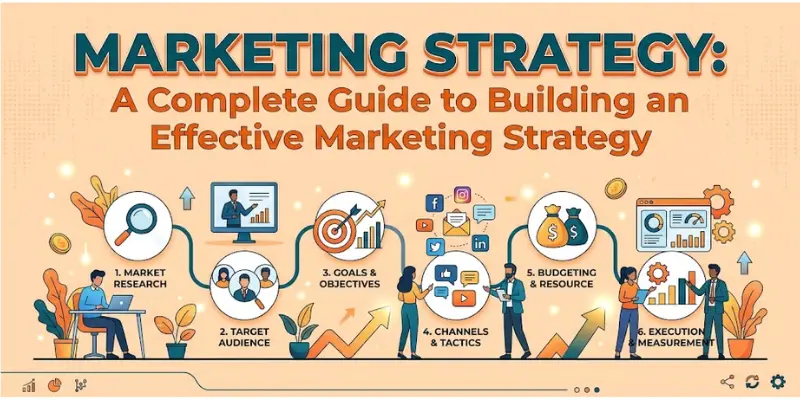
For a small business, startup, ecommerce company, service provider, or established brand, the purpose of a marketing strategy is not simply to promote a product. It is to determine who the business wants to reach, what value it offers, how it should be positioned, which channels are appropriate, how resources should be allocated, and how results will be measured.
The American Marketing Association’s marketing strategy resources describe marketing strategy as a coordinated plan that guides marketing efforts, tactics, and resources. A useful strategy therefore connects individual marketing activities with broader business objectives rather than treating every campaign as an isolated project.
A strong starting point is understanding broader marketing fundamentals, because strategy builds on concepts such as customer needs, segmentation, positioning, branding, the marketing mix, and value creation. At the same time, a dedicated marketing strategy needs to go further by explaining how those concepts will be applied to achieve measurable objectives.
What Is a Marketing Strategy?
A marketing strategy is a long-term framework that explains how a business will reach its target customers, communicate its value proposition, compete in the marketplace, and achieve defined marketing objectives.
A strategy answers several important questions. Who are you trying to reach? What problem does your product or service solve? Why should customers choose your business? Which markets and customer segments matter most? Where can you reach those customers? What message should they receive? How will you know whether your marketing activities are working?
The American Marketing Association’s guide to developing an effective marketing strategy describes strategy as a long-term blueprint that connects marketing efforts with broader business objectives. This distinction is important because individual marketing activities do not automatically create a strategy.
Posting on social media every day, publishing blog articles, running advertisements, or sending emails may all be marketing activities, but they do not necessarily provide strategic direction.
A strategy connects those activities to a purpose.
For example, a company might decide to target small businesses that need affordable accounting software. Its strategy could focus on demonstrating ease of use, educating owners through useful content, capturing relevant search demand, nurturing prospects through email, and using customer stories to build trust. The individual blog posts, advertisements, emails, and social posts would then support that larger direction.
Why Is a Marketing Strategy Important?
A clear marketing strategy helps businesses avoid disconnected marketing activities. Without strategic direction, a company may spend money on several channels without knowing which audiences it wants to attract or what outcome each activity should produce.
A marketing strategy provides a framework for making these decisions.
First, it helps a business understand its target market. Instead of attempting to communicate with everyone, marketers can identify customer groups with specific needs, problems, behaviors, and purchasing motivations.
Second, it creates consistency. When the value proposition, positioning, tone, and core message are clearly defined, customers are more likely to encounter a recognizable brand across different touchpoints.
Third, a marketing strategy helps businesses allocate resources. A company with limited funds may not be able to invest heavily in SEO, paid advertising, video, social media, email, events, and influencer marketing simultaneously. Strategy helps determine which activities deserve attention first.
Fourth, it creates measurable objectives. Instead of simply saying that a business wants more visibility, marketers can establish measurable goals related to qualified traffic, leads, sales, customer retention, revenue, or other business outcomes.
Finally, strategy makes optimization possible. When marketing activities are connected to defined objectives and KPIs, businesses can evaluate results and adjust their approach based on evidence.
A useful strategy should therefore be treated as a decision-making framework rather than merely a document.
Marketing Strategy vs. Marketing Plan
Marketing strategy and marketing plan are closely related, but they are not exactly the same thing.
A marketing strategy establishes the broader direction. It defines the target audience, positioning, value proposition, competitive approach, major objectives, and general channel direction.
A marketing plan turns that direction into specific activities, schedules, campaigns, responsibilities, and timelines.
For example, a company’s marketing strategy might be to become a trusted source of educational information for first-time small-business owners. Its marketing plan could include publishing two educational articles per week, creating a monthly webinar, sending a weekly newsletter, and running search advertisements for selected commercial keywords.
The strategy explains the direction and reasoning. The plan explains how that direction will be implemented during a specific period.
This distinction also helps prevent businesses from confusing activity with strategy. A calendar full of marketing tasks may represent a busy team, but it does not necessarily represent a coherent marketing direction.
Businesses can also connect marketing planning with broader business planning. The U.S. Small Business Administration’s business planning resources cover areas such as market research, competitive analysis, business planning, and understanding customers, all of which can inform marketing decisions.
Start With Business and Marketing Objectives
An effective marketing strategy should begin with a clear understanding of what the business is trying to achieve.
Marketing objectives should support broader business objectives. If the business wants to increase revenue, marketing may focus on qualified lead generation, customer acquisition, product demand, or expansion into a new customer segment.
Other objectives may include increasing brand awareness, entering a new market, improving customer retention, increasing website traffic from relevant audiences, generating leads, supporting a product launch, or increasing repeat purchases.
The objective should be specific enough to measure.
Instead of saying, “We want more customers,” a business could establish an objective such as increasing qualified leads by a defined percentage over a specific period. Instead of saying, “We need better visibility,” it could track growth in relevant organic traffic, branded searches, or audience engagement.
Clear objectives influence every later decision in the marketing strategy.
Conduct Market Research
Once objectives are established, the next step is understanding the market.
Market research helps businesses identify customer needs, market conditions, competitors, trends, buying behavior, and potential opportunities. It can include customer interviews, surveys, website analytics, competitor research, industry reports, reviews, sales data, search behavior, and other relevant sources.
A business should look beyond what customers say they want. It should also examine the problems they are trying to solve and the factors that influence their purchasing decisions.
Competitor research is equally important. Study how competing businesses position themselves, what products or services they emphasize, how they communicate value, which customer segments they target, what content they publish, and which channels they appear to use.
The purpose is not to copy competitors.
Instead, competitive analysis can reveal crowded areas, underserved audiences, messaging gaps, pricing differences, content opportunities, and potential ways to create a clearer position.
The U.S. Small Business Administration’s guidance on market research and competitive analysis also highlights the importance of understanding customers and competitors when evaluating a business opportunity.
Define Your Target Audience
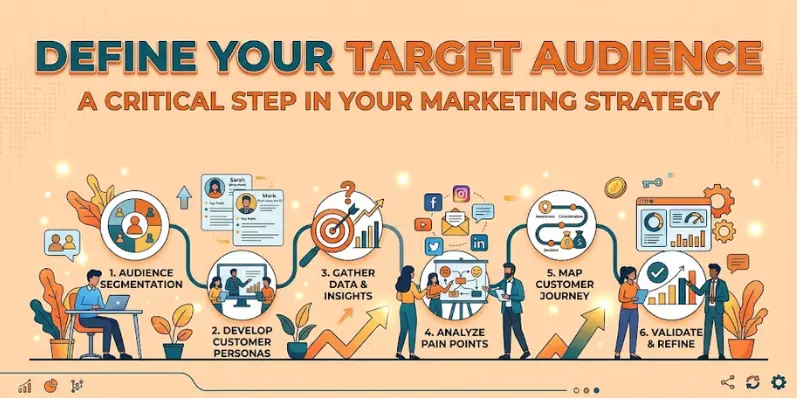
A marketing strategy becomes much more useful when the target audience is clearly defined.
A target audience is the group of people most relevant to a particular product, service, or marketing objective. Depending on the business, the audience may be defined by demographics, location, profession, income, interests, behavior, business size, purchasing patterns, or specific problems.
However, audience definition should go beyond demographics.
Marketers should understand what customers are trying to accomplish, what problems they face, what objections may prevent them from purchasing, what information they need, and where they look for solutions.
For example, a company selling project-management software might target small business owners who struggle with scattered tasks, missed deadlines, and poor team communication. The marketing message can then focus on organization, visibility, collaboration, and time savings.
This is more useful than simply defining the audience as “business owners.”
Create Customer Personas
Customer personas can help turn audience research into practical marketing decisions.
A persona is a simplified representation of a relevant customer group. It can include the customer’s role, needs, goals, challenges, purchasing motivations, preferred information sources, objections, and decision-making process.
A business does not necessarily need dozens of personas. In many cases, a small number of clearly defined customer profiles is more useful.
For each persona, marketers can ask:
What problem is this person trying to solve?
What motivates them to search for a solution?
What might stop them from buying?
What information do they need?
Which channels do they use?
What type of message would be most relevant?
The answers help shape content, advertising, offers, landing pages, and customer communication.
Develop a Strong Value Proposition
A value proposition explains why a customer should consider a company’s product or service.
It should communicate the value the business provides rather than simply describing features.
For example, a project-management platform may offer dashboards, task assignments, notifications, and reporting tools. Those are features. The value proposition could focus on helping teams organize projects, reduce missed deadlines, and improve visibility.
A strong marketing strategy uses the value proposition as a consistent foundation for messaging.
The value proposition should also be credible. Claims should be supported by the actual product experience, customer evidence, demonstrations, guarantees, service quality, or other meaningful proof.
When the value proposition is unclear, marketing messages often become generic. A business may describe itself as “high quality,” “innovative,” or “customer-focused” without explaining what those claims mean for the customer.
Specificity makes positioning more useful.
The broader AMA definition of marketing emphasizes creating, communicating, delivering, and exchanging offerings that have value for customers and other stakeholders. This provides useful context for why value should remain central to marketing strategy.
Use Segmentation, Targeting, and Positioning
Segmentation, targeting, and positioning, often called STP, provide a structured way to determine which customers a business should focus on and how it should present its offer.
Segmentation divides a broad market into meaningful groups.
Targeting determines which segment or segments deserve priority.
Positioning establishes how the brand or product should be understood in relation to customer needs and competing alternatives.
Segments can be based on geography, demographics, psychographics, behavior, purchasing needs, business characteristics, or other meaningful differences.
The important point is that segmentation should lead to better decisions.
If two customer groups have completely different needs, they may require different messages, offers, content, or channels. A marketing strategy can therefore become more relevant when businesses avoid treating every customer as identical.
Build Your Marketing Mix With the 4 Ps
The 4 Ps remain a useful framework for developing a marketing strategy: Product, Price, Place, and Promotion.
Product refers to what the business offers. This includes features, quality, design, packaging, service, functionality, and the customer experience surrounding the product.
Price refers to what customers pay and how pricing supports both customer value and business objectives. Pricing can influence positioning and customer expectations.
Place refers to distribution. It considers where and how customers can access the product or service.
Promotion covers how the business communicates with the target audience. It can include advertising, content marketing, public relations, social media, email, SEO, events, partnerships, and other promotional activities.
The 4 Ps should work together rather than being considered independently.
For example, a premium product with premium pricing may require distribution and promotional methods that support a premium position. A low-cost product may require a different combination of channels, messaging, pricing, and distribution.
Choose the Right Marketing Channels
A marketing strategy should not automatically include every available channel.
The right channels depend on the target audience, objective, budget, resources, product type, buying journey, and content capabilities.
Common marketing channels include SEO and organic search, content marketing, social media marketing, email marketing, paid search advertising, paid social advertising, influencer marketing, video marketing, affiliate marketing, events and partnerships, public relations, and traditional advertising.
The key is strategic fit.
If customers actively search Google before making a purchase, SEO and search advertising may be useful. If a product depends heavily on visual discovery, video and social platforms may be more relevant. If the business has an established customer database, email marketing can support retention and repeat purchases.
Digital channels can also work together rather than operating independently. GrandsBusiness’s Digital Marketing guide explains how SEO, content, social media, email, paid advertising, websites, video, and analytics can connect around common business objectives.

Create a Content Strategy
Content should support the marketing strategy rather than exist simply because a business needs “more content.”
A content strategy determines what information should be created, who it is for, which stage of the customer journey it supports, and what action it should encourage.
Educational content can attract people who are researching a problem. Comparison content can support consideration. Case studies and testimonials can build confidence. Product pages and demonstrations can support purchasing decisions. Retention content can help existing customers gain more value from a product.
Content can also strengthen a brand’s positioning.
For example, a business that wants to become known for practical expertise can consistently publish detailed educational resources, original research, demonstrations, expert commentary, and useful guides.
The objective is not to publish as much as possible. It is to publish content that serves a clear purpose.
Develop Consistent Marketing Messaging
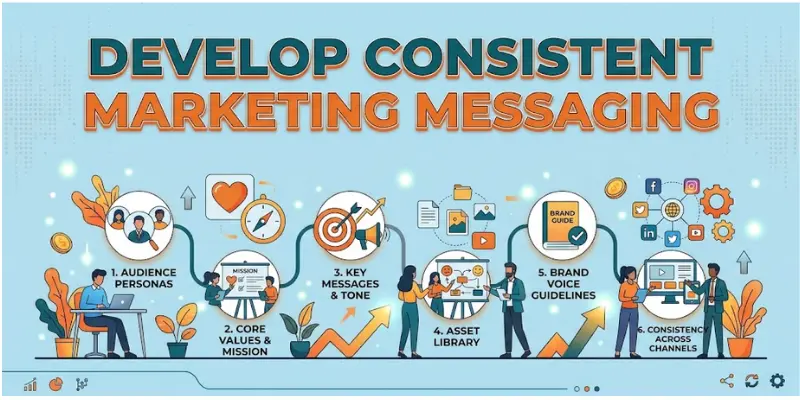
A consistent message helps customers understand what a business represents.
Consistency does not mean repeating exactly the same sentence everywhere. Instead, the core value proposition, positioning, tone, and important benefits should remain recognizable across different channels.
Website content, advertisements, social media posts, emails, videos, sales materials, and landing pages should communicate compatible ideas.
This becomes especially important when multiple people or departments create marketing content. A clear messaging framework reduces the risk of contradictory claims or inconsistent brand positioning.
Messaging should also be adapted to customer intent.
Someone discovering a brand for the first time may need educational information. Someone comparing products may need specifications, evidence, reviews, or pricing information. Someone who has already purchased may need onboarding or support.
The core message can remain consistent while the communication changes according to the customer’s stage.
Set a Marketing Budget
Budgeting determines what a business can realistically execute.
A marketing budget can include spending on advertising, content production, software, agencies, freelancers, events, sponsorships, design, video production, influencer partnerships, research, and other marketing activities.
Budget allocation should be connected to objectives.
A business should know what it is trying to achieve before deciding how much to spend. It should also establish how results will be evaluated.
Not every marketing activity needs the same budget. Some channels can be developed through internal resources, while others require significant investment.
A practical approach is to establish core spending for proven activities while reserving some resources for controlled experimentation.
Budget decisions should therefore be considered alongside audience, objectives, positioning, and expected outcomes rather than treated as an isolated expense.
Create a Customer Journey
Customers rarely move from seeing an advertisement directly to purchasing without additional interactions.
A typical customer journey may include awareness, consideration, conversion, and retention, although real customer journeys are often less linear.
During awareness, a person may discover a brand through search, social media, advertising, video, a recommendation, or another source.
During consideration, the person may compare solutions, read reviews, visit websites, watch demonstrations, or download resources.
During conversion, the person may purchase, submit a form, request a quote, book a service, or take another valuable action.
After conversion, the business can focus on onboarding, customer support, retention, repeat purchases, referrals, and long-term relationships.
A strong marketing strategy considers these stages rather than focusing exclusively on acquisition.
Measure Marketing Performance With KPIs
A marketing strategy should define how success will be measured.
Key performance indicators, or KPIs, depend on the objective.
For awareness, useful indicators may include reach, impressions, video views, branded search activity, or relevant engagement.
For website acquisition, marketers may monitor organic traffic, referral traffic, landing-page performance, engagement, and new users.
For lead generation, important metrics can include qualified leads, conversion rate, cost per lead, and lead-to-customer rate.
For ecommerce, marketers may monitor purchases, revenue, average order value, conversion rate, customer acquisition cost, and customer lifetime value.
For retention, metrics may include repeat purchases, churn, retention rate, customer satisfaction, and engagement.
The important principle is to connect metrics to business outcomes.
Traffic alone does not necessarily mean that a marketing strategy is working. A website can receive substantial traffic while generating few qualified leads or sales.
Use Marketing Analytics for Better Decisions
Analytics transforms marketing performance into information that can guide future decisions.
A marketer should not only ask whether a campaign received clicks. The more important question is what happened after those clicks.
Did visitors engage with the page?
Did they submit a form?
Did they purchase?
Did they return later?
Which audience segments converted?
Which channels contributed to the customer journey?
These questions allow marketers to move from activity-based reporting toward outcome-based decision-making.
For digital marketing, Google Analytics attribution guidance explains how credit can be assigned to different marketing efforts along a user’s path toward a key event. This can help businesses examine whether channels such as email, paid advertising, search, or other interactions contributed to meaningful actions.
Analytics can also reveal that a channel plays a supporting role rather than generating the final conversion directly. A customer may first discover a business through search, interact with social content later, receive an email, and eventually convert through a direct visit.
This is why marketing measurement should consider the broader customer journey.
Understand Attribution and Customer Touchpoints
Attribution is particularly useful when customers interact with multiple marketing channels before taking an important action.
For example, a potential customer may discover a company through an organic search result, return through an email campaign, click a paid advertisement later, and finally submit a form.
Looking only at the final interaction can hide the contribution of earlier touchpoints.
Google Analytics provides key event attribution path reporting, which shows paths users take before completing key events and provides information about touchpoints, revenue, and time to key events.
The purpose is not to assume that one channel deserves all the credit. Instead, attribution can provide additional context when evaluating how marketing channels work together.
Implement, Test, and Optimize the Strategy
A marketing strategy should not be treated as a document that is created once and never changed.
After implementation, marketers should monitor performance and compare actual results with objectives.
If an activity performs well, the business can investigate why and determine whether it can be expanded.
If something underperforms, the next step is not always to eliminate it immediately. The business may need to examine the audience, offer, message, creative, landing page, budget, timing, or measurement setup.
Testing can help identify improvements.
A business might test two headlines, different calls to action, different landing-page layouts, alternative audience segments, or different promotional messages.
Optimization is therefore a continuous part of a marketing strategy.
Google Analytics provides tools for examining key event attribution models, allowing marketers to compare how different attribution approaches affect the valuation of marketing channels. This can provide useful context when reviewing campaign performance.
Common Marketing Strategy Mistakes
One common mistake is trying to reach everyone. A broad audience can make messaging vague and resource allocation difficult.
Another mistake is choosing channels before understanding the audience. Businesses sometimes select platforms because competitors use them rather than because their own customers are active there.
A third mistake is focusing on vanity metrics. Likes, impressions, and traffic can be useful indicators, but they do not automatically demonstrate business success.
Another problem is inconsistent positioning. If a company presents itself as premium in one channel and discount-focused in another, customers may struggle to understand its market position.
Poor measurement is another major issue. Without appropriate tracking, it becomes difficult to know which activities are contributing to meaningful outcomes.
Finally, some businesses change direction too frequently. Strategy requires flexibility, but constant changes without enough data can prevent meaningful learning.
A better approach is to establish clear objectives, allow sufficient time for meaningful measurement, and then use evidence to determine what should be improved.
Marketing Strategy Examples
Consider a fictional online accounting software company targeting small businesses.
The company’s business objective is to increase recurring revenue. Its marketing objective is to generate more qualified business-owner leads.
The target audience consists of small business owners who struggle with bookkeeping, invoicing, reporting, and financial organization.
The value proposition focuses on making financial management easier and more organized without requiring advanced accounting knowledge.
The company could build an SEO and content strategy around practical accounting questions, publish educational resources, offer templates, create product demonstrations, and use email to nurture interested visitors.
Paid search could capture users with stronger commercial intent, while social media could distribute educational content and customer stories.
The company could measure organic qualified traffic, lead conversion rate, cost per lead, trial registrations, paid conversions, customer acquisition cost, and recurring revenue.
Notice that the marketing strategy is not simply “do SEO and social media.” Every channel has a role connected to the audience and objective.
How Small Businesses Can Build a Marketing Strategy
Small businesses do not need a huge marketing department to develop a useful strategy.
Start by defining one or two important business objectives.
Then identify the most valuable customer group and understand its problems.
Research competitors and identify where the business can provide meaningful value.
Define a clear value proposition and a small number of core messages.
Choose a manageable number of channels instead of attempting everything at once.
Create useful content or campaigns that directly support the objective.
Establish a realistic budget and measurement framework.
Finally, review performance regularly and improve the approach based on evidence.
A smaller, focused strategy can be easier to execute than a complicated strategy involving too many channels.
Digital Marketing and Marketing Strategy
Digital marketing is an important part of modern marketing, but marketing strategy is broader than digital channels alone.
A business may use SEO, email, social media, paid advertising, content marketing, and online video as part of its digital marketing activities. However, its overall marketing strategy may also include product decisions, pricing, distribution, partnerships, public relations, events, sales support, and offline promotion.
This distinction is important because businesses should not confuse the tools with the strategy.
A social media platform is a channel.
SEO is a marketing method.
Email is a communication channel.
Paid advertising is a promotional method.
The marketing strategy determines why these tools are being used, who they are intended to reach, what message they should communicate, and what outcome they are expected to support.
For readers who want to understand the broader digital side separately, the Fundamentals of Digital Marketing guide provides a more focused introduction to digital channels, campaigns, and online marketing activities.
How Often Should a Marketing Strategy Be Reviewed?
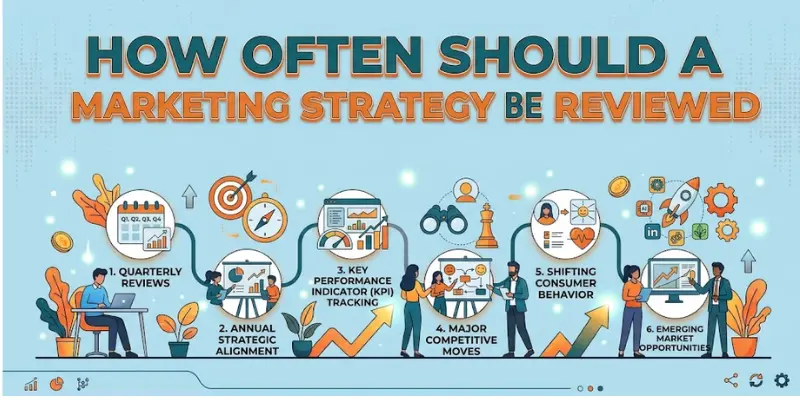
A marketing strategy should be reviewed regularly rather than left unchanged indefinitely.
The review schedule depends on the business and market. Some businesses may conduct formal reviews quarterly or semiannually, while others may need more frequent monitoring because their market or customer behavior changes quickly.
A review should examine objectives, audience changes, competitive developments, channel performance, budget allocation, customer feedback, and KPI trends.
A strategy may also need revision after a major business event such as a new product launch, market expansion, pricing change, acquisition, rebranding, or significant change in customer behavior.
The strategy should therefore remain stable enough to provide direction while being flexible enough to respond to meaningful changes.
Frequently Asked Questions About Marketing Strategy
What is a marketing strategy in simple words?
A marketing strategy is a structured approach that explains how a business will reach its target customers, communicate its value, compete in its market, and achieve specific marketing objectives.
What are the main elements of a marketing strategy?
Common elements include business objectives, target audience, market research, competitive analysis, positioning, value proposition, messaging, marketing channels, budget, content, customer journey, KPIs, and optimization.
What is the difference between marketing strategy and marketing tactics?
Strategy provides the overall direction and reasoning. Tactics are the specific actions used to execute that direction, such as publishing an article, running an advertisement, sending an email, or creating a social media campaign.
What are the 4 Ps in marketing strategy?
The 4 Ps are Product, Price, Place, and Promotion. They provide a framework for evaluating an offer and determining how it should be positioned, distributed, priced, and promoted.
Is digital marketing the same as marketing strategy?
No. Digital marketing refers to marketing activities performed through digital channels, while marketing strategy is the broader framework that determines objectives, audience, positioning, channels, messaging, resources, and measurement.
Why is target audience important in marketing strategy?
A clearly defined target audience helps a business create more relevant messages, choose appropriate channels, develop useful content, and allocate resources toward customers who are most relevant to its objectives.
How do you measure a marketing strategy?
Measurement depends on the objective. Relevant metrics can include qualified leads, conversion rate, customer acquisition cost, revenue, customer retention, organic traffic, engagement, purchases, and customer lifetime value.
Can a small business create its own marketing strategy?
Yes. A small business can begin with a simple framework covering its objective, target customer, problem solved, value proposition, primary channels, budget, content or promotional activities, and KPIs.
Conclusion
A marketing strategy gives a business a structured way to decide who it wants to reach, what value it provides, how it should communicate that value, and how its marketing activities will support measurable business objectives.
The process begins with clear goals and market research. From there, businesses can define their target audience, develop customer personas, establish a value proposition, analyze competitors, choose a position, and build a suitable marketing mix.
The next stage is selecting channels, developing content and messaging, setting a realistic budget, understanding the customer journey, and defining KPIs. Once the strategy is implemented, analytics and testing provide the information needed to improve performance.
The most useful marketing strategy is not necessarily the one with the largest number of channels or the biggest budget. It is one where the audience, value proposition, objectives, channels, resources, and measurement system work together.
As markets and customer behavior change, businesses should continue reviewing their strategy and adapting their approach. Readers who want to explore practical examples can also visit the Recent Innovative Marketing Examples article.
A clear strategy turns marketing from a collection of disconnected activities into a coordinated process focused on customers, value, measurable objectives, and sustainable business growth.






- Be Respectful
- Stay Relevant
- Stay Positive
- True Feedback
- Encourage Discussion
- Avoid Spamming
- No Fake News
- Don't Copy-Paste
- No Personal Attacks
- Be Respectful
- Stay Relevant
- Stay Positive
- True Feedback
- Encourage Discussion
- Avoid Spamming
- No Fake News
- Don't Copy-Paste
- No Personal Attacks
