Types of Digital Marketing: A Complete Guide to the Main Digital Marketing Channels
Published: 04 Oct 2026
Digital marketing has become an essential part of how businesses attract customers, build brand awareness, generate leads, and increase sales. Instead of depending only on traditional advertising, businesses can use search engines, websites, social media platforms, email, video, online advertising, and other digital channels to connect with potential customers.
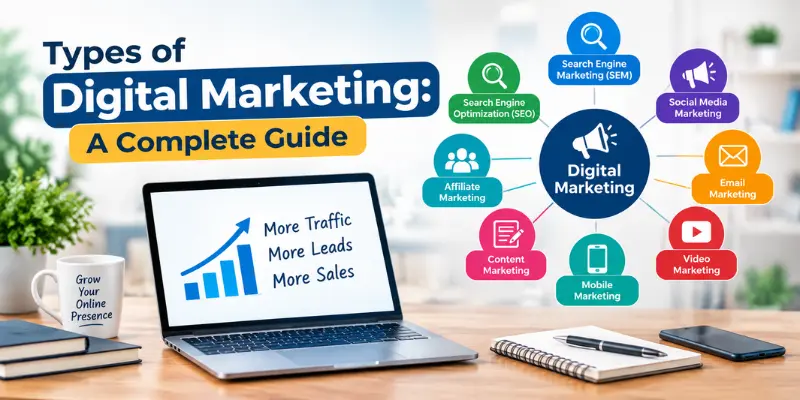
There are many types of digital marketing, and each one serves a different purpose. Search engine optimization helps businesses improve organic visibility, while pay-per-click advertising can provide paid visibility for specific searches and audiences. Content marketing focuses on providing useful information, social media marketing encourages engagement, and email marketing provides a direct communication channel with subscribers. Other approaches, including video marketing, influencer marketing, affiliate marketing, mobile marketing, display advertising, and local digital marketing, can also support different stages of the customer journey.
Understanding these channels is important because businesses do not necessarily need to use every available marketing method. The right combination depends on the target audience, business goals, industry, budget, resources, and customer journey.
This guide explains the major types of digital marketing, how they work, what they can accomplish, and how businesses can combine them into a practical online marketing approach.
What Is Digital Marketing?
Digital marketing is the promotion of products, services, brands, or organizations through digital channels and technologies. These channels can include websites, search engines, social media platforms, email, mobile applications, video platforms, online advertising networks, and other internet-based environments.
Digital marketing is broader than simply placing advertisements online. A business can use organic search optimization, educational content, social media posts, email campaigns, paid advertising, videos, influencer partnerships, affiliate relationships, and analytics as part of its overall digital marketing activity.
According to Amazon Ads’ digital marketing guide, digital marketing can involve websites, organic and paid social media, search engine marketing, SEO, email marketing, digital advertising, and other online channels.
One important characteristic of digital marketing is measurability. Businesses can monitor website visits, impressions, clicks, engagement, leads, conversions, purchases, and other actions. This information can help marketers understand how campaigns are performing and where improvements may be necessary.
If you are looking for a broader introduction before exploring individual channels, the Digital Marketing guide on Grands Business provides an overview of the wider concept, strategies, channels, benefits, and applications of digital marketing.
Why Are There Different Types of Digital Marketing?
Different types of digital marketing exist because customers do not all discover or evaluate businesses in the same way. One person may use Google to find an answer, another may discover a product through social media, while another may respond to an email, video, recommendation, or online advertisement.
Each digital marketing channel also has a different role. SEO generally focuses on organic search visibility, while PPC focuses on paid visibility. Content marketing provides useful information, whereas email marketing can nurture an audience that has already subscribed. Social media can support communication and community building, while affiliate and influencer marketing can extend a company’s reach through third parties.
This means there is no requirement for every business to use every digital marketing channel. A small local business may concentrate on local SEO, social media, email, and useful website content. A B2B software company may use SEO, content marketing, LinkedIn, webinars, email, and paid search. An ecommerce business may combine product SEO, paid advertising, social media, influencers, and email marketing.
Understanding the purpose of each channel allows businesses to create a focused strategy instead of simply publishing content everywhere.
1. Search Engine Optimization (SEO)
Search engine optimization, commonly called SEO, is one of the most widely used types of digital marketing. It involves improving a website and its content so relevant pages can be discovered more easily through organic search results.
When people search for information, products, services, or solutions, search engines attempt to provide relevant results. SEO helps businesses create pages that search engines can understand while also providing useful information to searchers.
SEO can include several areas. On-page SEO focuses on content, titles, headings, internal links, keyword relevance, and the overall usefulness of a page. Technical SEO can involve crawlability, indexability, site structure, mobile usability, and other technical elements. Off-page SEO can involve references and links from other websites.
Keyword research is another important part of SEO because it helps marketers understand what audiences search for. However, simply repeating keywords does not create a complete SEO strategy. Content should address the searcher’s needs and provide meaningful information.
Google’s SEO Starter Guide explains that SEO helps search engines understand content and helps users discover websites through search. It also recommends creating useful, well-organized content and using relevant links where they provide additional context.
For example, a business selling accounting software could publish useful guides about bookkeeping, invoices, cash flow, accounting terminology, and financial reporting. These resources can attract people who are researching problems related to the company’s products.
2. Pay-Per-Click (PPC) Advertising
Pay-per-click advertising is a paid form of digital marketing in which advertisers generally pay when someone clicks an advertisement. Search advertising is one of the most common examples.
A business can create campaigns around relevant keywords and show advertisements when users perform related searches. PPC is different from SEO because the business pays for advertising placement instead of relying on organic search visibility.
For example, a company selling office furniture might create paid campaigns around searches such as “office chairs online” or “ergonomic office chair.” The advertiser can define budgets, audiences, locations, keywords, advertisements, and landing pages.
PPC also extends beyond search engines. Businesses can use paid social advertising, display advertising, video advertising, shopping campaigns, and other digital advertising formats.
An effective PPC campaign requires more than setting a budget. Marketers need relevant advertisements, appropriate targeting, useful landing pages, conversion tracking, and ongoing optimization. Important measurements can include clicks, click-through rate, cost per click, conversions, cost per conversion, and revenue.
For additional information about paid search, Amazon Ads’ guide to search engine marketing explains SEM as a paid search approach that uses PPC to increase visibility in search results.
3. Content Marketing
Content marketing focuses on creating and distributing useful, relevant, and consistent content for a defined audience. It is one of the types of digital marketing that can support several other channels at the same time.
Blog posts, guides, tutorials, case studies, videos, infographics, reports, podcasts, and educational resources can all be used as content marketing formats.
The purpose is not simply to publish information. Effective content can answer audience questions, solve problems, demonstrate expertise, support decision-making, and move potential customers through the buying journey.
For example, a financial software company could publish articles explaining budgeting, invoicing, cash-flow management, accounting terminology, and financial reporting. Someone searching for these topics may discover the company before they are ready to purchase.
Content marketing also works closely with SEO. A well-researched article can attract organic search traffic, while the same content can be repurposed into social media posts, email content, videos, or downloadable resources.
Businesses can also learn broader marketing concepts through the Marketing Fundamentals guide on Grands Business, while keeping content marketing focused specifically on creating useful information for digital audiences.
4. Social Media Marketing
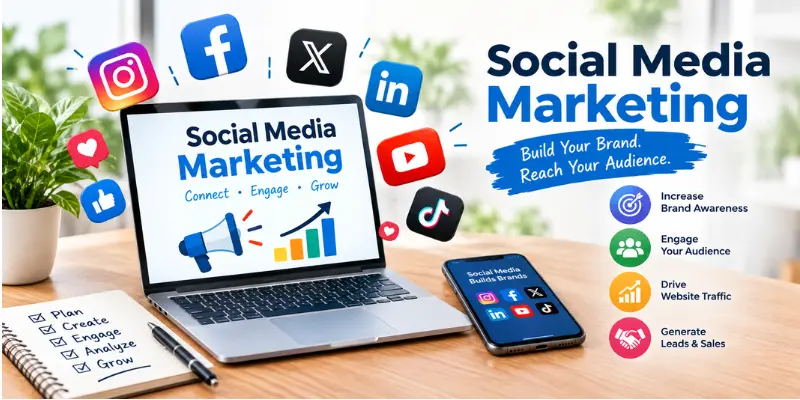
Social media marketing uses social platforms to distribute content, communicate with audiences, build communities, increase brand awareness, and support business objectives.
Platforms can include Facebook, Instagram, LinkedIn, YouTube, TikTok, Pinterest, and other networks. However, businesses do not necessarily need to use every platform. The right choice depends on where the target audience spends time and what type of content the business can produce effectively.
A B2B company may use LinkedIn for professional content, industry insights, and lead generation. A consumer brand may rely more heavily on Instagram or TikTok for visual content and short-form videos. YouTube can support longer educational content, product demonstrations, tutorials, and reviews.
Social media marketing can be organic or paid. Organic activity includes regular posts, community interaction, responses, and unpaid videos. Paid social advertising uses advertising budgets to reach selected audiences.
Successful social media marketing is not simply about posting frequently. Businesses need useful content, consistent messaging, audience interaction, and measurement. Comments, shares, saves, messages, clicks, leads, and conversions can provide useful information about audience response.
5. Email Marketing
Email marketing allows businesses to communicate directly with people who have chosen to receive email communications. It can be used for newsletters, educational content, product announcements, promotions, onboarding, customer retention, and follow-up campaigns.
One advantage of email marketing is that businesses can communicate with an audience they have already acquired. Instead of relying entirely on search engines or social media algorithms to reach people again, a company can send relevant information directly to subscribers.
Segmentation can make email campaigns more useful. A business might separate new subscribers, existing customers, prospective customers, and people interested in particular products. Different groups can then receive messages that are more relevant to their interests or stage in the customer journey.
Automation can also support email marketing. For example, a company might create a welcome sequence for new subscribers or send educational messages after someone downloads a resource.
Important measurements can include delivery rate, opens, clicks, website activity, leads, purchases, unsubscribes, and revenue. The right metrics depend on the purpose of the campaign.
6. Video Marketing
Video marketing uses video content to educate, demonstrate, entertain, communicate, or promote products and services. It has become an important digital marketing channel because businesses can use video across websites, social networks, advertising platforms, and video-hosting services.
Short-form videos can introduce a brand, answer questions, demonstrate products, or explain concepts quickly. Longer videos can provide tutorials, webinars, product demonstrations, interviews, reviews, and educational lessons.
For example, a software company might publish a tutorial showing how to complete a particular task. A furniture company could create a video demonstrating how a product is assembled. A travel business could use destination videos to introduce places and experiences.
Video can also strengthen other types of digital marketing. A video can be embedded in an SEO article, shared through social media, included in an email campaign, or used as part of a paid advertising campaign.
Amazon Ads identifies video marketing as one of the digital marketing formats businesses can use to promote products, brands, or services.
The most important factor is not necessarily production complexity. A useful video that clearly answers a customer’s question can be more valuable than a highly produced video without a clear purpose.
7. Influencer Marketing
Influencer marketing involves collaborating with individuals who have an established audience and influence within a particular subject or community. A creator may promote a product, service, campaign, or brand through social posts, videos, reviews, tutorials, or other content.
Influencer marketing can be useful when a business wants to reach a specific community. For example, a fitness company might work with fitness creators, while a technology company could collaborate with technology reviewers.
The size of an influencer’s audience is not the only factor that matters. Audience relevance, engagement, content quality, credibility, and alignment with the brand can also be important.
Businesses should define campaign objectives before working with creators. Possible objectives include awareness, website traffic, engagement, leads, app installations, or sales.
Influencer marketing also requires transparency. Paid or sponsored relationships should be disclosed according to applicable laws, platform requirements, and advertising standards.
8. Affiliate Marketing
Affiliate marketing is a performance-based approach in which external publishers, creators, websites, or partners promote products or services and may receive a commission for qualifying actions.
An affiliate might publish a product review, comparison article, tutorial, video, or recommendation containing a tracked referral link. When a visitor completes the required action, such as making a purchase, the affiliate can receive compensation according to the program’s terms.
Affiliate marketing can extend a company’s reach without requiring the business to create every piece of promotional content itself. It can work particularly well for ecommerce, software, online services, education products, and other businesses with trackable conversions.
However, affiliate programs need clear terms and monitoring. Businesses should consider commission structures, attribution windows, partner quality, promotional methods, and compliance requirements.
Affiliate marketing is different from influencer marketing even though the two can overlap. Influencer campaigns may focus on awareness or engagement and can involve fixed payments, free products, commissions, or combinations. Affiliate programs generally emphasize measurable actions and performance-based compensation.
9. Mobile Marketing
Mobile marketing focuses on reaching people through smartphones and tablets. It can include mobile-friendly websites, SMS campaigns, mobile applications, push notifications, mobile advertising, location-based messages, and social media experiences designed for mobile users.
Because many customers interact with businesses through mobile devices, mobile usability is relevant to almost every type of digital marketing. A person might discover a company through a mobile search, open its website, watch a video, read an email, or complete a purchase from a smartphone.
SMS marketing can be used for reminders, promotions, order updates, appointments, and other communications when users have provided appropriate permission. Mobile applications can provide another direct communication channel through notifications and personalized experiences.
Mobile marketing should be relevant and respectful. Excessive notifications, poorly designed pages, slow experiences, or unwanted messages can create a negative customer experience.
10. Display Advertising
Display advertising uses visual advertisements that can appear across websites, applications, and digital advertising networks. Display ads can contain images, text, animation, interactive elements, or video.
Unlike search advertising, display advertising can reach users who are not actively searching for a particular product or service. This makes it useful for awareness, remarketing, product promotion, and maintaining brand visibility.
For example, someone might visit an ecommerce website without making a purchase. A business can use remarketing campaigns to show relevant advertisements to that person later, subject to applicable privacy and advertising requirements.
Display campaigns require appropriate creative assets, audience targeting, frequency management, and performance measurement. Marketers can monitor impressions, clicks, click-through rate, conversions, and other relevant outcomes.
Amazon Ads describes display advertising as a format that can combine advertising copy, visual elements, calls to action, and links to landing pages.
11. Search Engine Marketing (SEM)
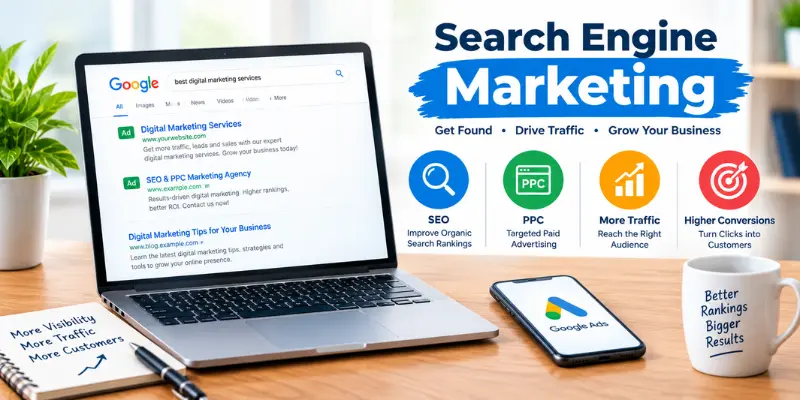
Search engine marketing, commonly abbreviated as SEM, is often used to describe paid marketing through search engines. It is useful to distinguish this paid activity from SEO, which focuses on organic search visibility.
Paid search allows businesses to advertise for selected search terms and reach people who are actively using search engines. This can be valuable when customers have clear commercial intent.
For example, a company selling accounting software might create paid search campaigns around terms related to accounting software, invoicing software, or business finance tools.
SEO and paid search can operate alongside each other. SEO can support long-term organic visibility, while paid search can provide advertising visibility for selected keywords and audiences.
Businesses can use performance data from paid search to understand audience language, search intent, landing-page performance, and conversion behavior. Those insights can sometimes inform broader marketing activities.
12. Marketing Automation
Marketing automation uses software to automate repetitive marketing tasks and customer communications. It can support email sequences, lead nurturing, segmentation, customer journeys, notifications, and other workflows.
For example, a visitor might download a business guide and provide an email address. An automated workflow could send a welcome message, provide additional educational content, and later introduce a relevant product or service.
Automation can save time and make communication more consistent, but it should not replace marketing strategy. Poorly designed automated campaigns can send irrelevant messages or overwhelm subscribers.
Effective automation starts with clear audience segments, useful content, appropriate timing, permission, and measurable goals. Businesses should regularly review automated journeys to ensure they remain accurate and useful.
13. Local Digital Marketing
Local digital marketing focuses on reaching customers in a particular geographic area. It can combine local SEO, business listings, websites, social media, reviews, location-specific content, and local advertising.
A restaurant, dental clinic, repair company, or local retailer may not need to compete for broad national searches. Instead, the business can focus on searches that include its city, neighborhood, service area, or location-specific intent.
Accurate business information is particularly important for local visibility. Businesses should keep their name, address, phone number, operating information, website details, and other important information accurate across relevant platforms.
Local content can also help. A service business could publish location-specific guides, answer local customer questions, and create pages describing the areas it serves.
14. Digital PR
Digital public relations, often called digital PR, uses online publications, media websites, industry platforms, interviews, expert commentary, digital press releases, and other online exposure to build awareness and credibility.
A company may use digital PR when launching a product, announcing research, sharing original data, participating in an industry discussion, or providing expert commentary.
Digital PR can extend brand visibility beyond traditional advertising. When reputable publications or relevant websites mention a company, the exposure can introduce the brand to new audiences.
However, digital PR should focus on genuinely useful or newsworthy information rather than producing promotional material solely for links. Quality, relevance, and credibility remain important.
15. Conversational Marketing
Conversational marketing uses tools such as live chat, messaging platforms, chatbots, and other direct communication systems to interact with potential or existing customers.
A website chatbot can answer common questions, help users find information, collect basic lead details, or direct visitors to relevant resources. Live chat can allow customers to communicate with a representative when they need more personalized assistance.
Conversational marketing can be useful when customers have questions before making a purchase. For example, someone buying software may want clarification about pricing, features, integrations, or technical requirements.
The quality of the interaction matters. Automated systems should provide useful answers and make it easy for users to reach human support when they need additional assistance.
Organic vs. Paid Types of Digital Marketing
Another way to understand types of digital marketing is to classify channels according to how visibility is obtained.
Organic marketing generally refers to activities where businesses do not directly pay for every impression or click. SEO, organic content marketing, and unpaid social media activity can fall into this category.
Paid marketing involves paying platforms, publishers, creators, or advertising networks for exposure. PPC, display advertising, paid social advertising, sponsored content, and many influencer campaigns are examples.
Owned marketing focuses on digital assets controlled by the business, such as its website, blog, email list, mobile application, and customer database.
Earned exposure refers to attention generated by others, such as reviews, editorial mentions, organic shares, recommendations, and user-generated content.
A business can combine these approaches. For example, SEO can build organic traffic, paid advertising can accelerate visibility, an email list can nurture visitors, and customer reviews can provide additional credibility.
How to Choose the Right Type of Digital Marketing
Choosing among the different types of digital marketing should begin with the business objective rather than the platform.
If the objective is long-term organic visibility, SEO and content marketing may be relevant. If the objective is paid exposure for high-intent searches, PPC may be useful. If the objective is community engagement, social media can play an important role. If a business already has an email audience, email marketing can support retention and conversion.
The target audience is equally important. Businesses should understand where customers search, what content they consume, which platforms they use, and what questions they ask before making decisions.
Budget and resources also matter. Some channels require advertising expenditure, while others require more time, content production, technical expertise, or community management.
Amazon Ads recommends considering customer needs, business goals, available channels, content assets, and performance metrics when developing a digital marketing strategy.
Instead of launching every channel simultaneously, businesses can start with a small number of relevant channels, measure performance, and expand when there is enough information to justify doing so.
How Different Types of Digital Marketing Work Together
The strongest digital strategies often combine several channels rather than treating each one as completely independent.
Imagine an online business selling professional software. SEO can bring visitors who are searching for solutions. Content marketing can educate those visitors. Social media can distribute useful articles and build awareness. A downloadable guide can turn some visitors into email subscribers. Email marketing can nurture those subscribers. PPC can reach users searching for high-intent commercial terms. Retargeting can reconnect with people who visited but did not convert.
This creates a connected customer journey rather than a collection of unrelated campaigns.
The same principle applies to smaller businesses. A local service provider could use local SEO to attract nearby searches, publish helpful articles to answer customer questions, use social media to share projects, collect customer reviews, and use email to maintain relationships with existing customers.
The goal is not to maximize the number of channels. The goal is to connect appropriate channels around the same audience and business objective.
Businesses looking for examples of how different marketing approaches can be applied can also explore Recent Innovative Marketing Examples on Grands Business.
Common Mistakes When Using Digital Marketing Channels
One common mistake is trying to use every channel at once. Managing SEO, multiple social platforms, email, video, PPC, influencers, and other campaigns can become difficult without sufficient resources.
Another mistake is choosing channels because they are popular rather than because the target audience uses them. A platform can have millions of users but still be a poor fit for a particular business.
Focusing only on traffic can also create problems. High website traffic does not automatically mean high-quality leads or sales. Businesses should connect traffic measurements with meaningful outcomes such as qualified leads, purchases, revenue, retention, or other relevant objectives.
Ignoring measurement is another issue. Without proper tracking, it becomes difficult to identify which channels contribute to meaningful results.
Finally, businesses sometimes change direction too quickly. Some organic activities require time to produce meaningful patterns, while paid campaigns may provide faster feedback. A sensible approach is to establish clear measurement criteria and review performance consistently.
How to Measure Different Types of Digital Marketing
Different channels require different metrics. SEO performance can be evaluated through organic visibility, clicks, impressions, rankings, engagement, conversions, and revenue where appropriate.
PPC campaigns can be measured using impressions, clicks, click-through rate, cost per click, conversions, cost per conversion, return on ad spend, and revenue.
Social media measurement can include reach, impressions, engagement, follower growth, website traffic, leads, and conversions. Email campaigns may use delivery, opens, clicks, unsubscribes, conversions, and revenue.
Content marketing can be evaluated through organic traffic, engagement, assisted conversions, leads, downloads, and other relevant outcomes. Video marketing can involve views, watch time, engagement, clicks, and conversions.
The most useful metric depends on the objective. A brand-awareness campaign should not necessarily be judged by the same measurement as an ecommerce sales campaign.
Amazon Ads also emphasizes tracking campaign metrics and continuing to optimize digital marketing activity based on performance data.
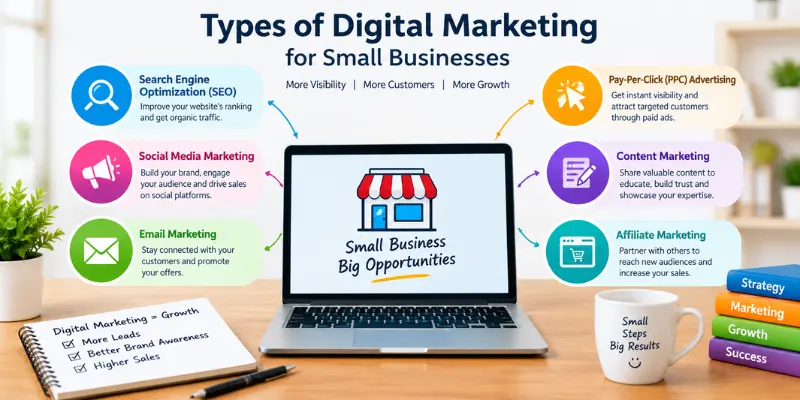
Types of Digital Marketing for Small Businesses
Small businesses do not need a large marketing department to begin using digital channels. A practical approach can start with a website, useful content, search visibility, one relevant social platform, and a simple method for communicating with existing customers.
For a local service business, local SEO and reviews may be important. For an ecommerce store, product SEO, social media, email, and paid advertising may be more relevant. For a professional service provider, educational content, search visibility, LinkedIn, email, and lead-generation campaigns can support the customer journey.
The important factor is consistency. A business is generally better served by maintaining a few relevant channels effectively than by creating inactive profiles on many platforms.
Businesses can also review their existing marketing activities before adding new channels. The goal should be to identify gaps in the customer journey and choose channels that address those gaps.
For readers who want to understand the broader marketing concepts behind these activities, the Marketing Fundamentals guide provides a useful related resource.
Frequently Asked Questions About Types of Digital Marketing
What are the main types of digital marketing?
The main types include SEO, PPC advertising, content marketing, social media marketing, email marketing, video marketing, influencer marketing, affiliate marketing, mobile marketing, display advertising, local digital marketing, digital PR, and marketing automation. Different businesses use different combinations depending on their goals and audiences.
How many types of digital marketing are there?
There is no single universally fixed number. Different organizations group channels differently. Some guides identify a smaller number of major categories, while others separate additional channels such as mobile marketing, display advertising, influencer marketing, or digital PR. The classification depends on how individual tactics and channels are defined.
Which type of digital marketing is best for beginners?
Beginners can start by understanding SEO, content marketing, social media, email, paid advertising, and analytics. These areas provide a useful foundation for understanding how customers discover, evaluate, and interact with businesses online.
Readers who want to study the foundation first can also explore Fundamentals of Digital Marketing before moving into individual channels.
Is SEO a type of digital marketing?
Yes. SEO is one of the major types of digital marketing. It focuses on improving a website’s ability to appear for relevant organic searches while providing useful content and experiences for users.
Is social media marketing a type of digital marketing?
Yes. Social media marketing is a major digital marketing channel. It can involve organic posts, community interaction, social content, paid advertising, creator collaborations, and other activities on social platforms.
What is the difference between SEO and PPC?
SEO focuses primarily on earning organic visibility in search results, while PPC involves paying for advertising placements. SEO can require ongoing content and technical work, whereas PPC can provide paid visibility according to campaign budgets and targeting settings.
Can a business use multiple types of digital marketing?
Yes. Businesses commonly combine several channels. SEO can attract organic traffic, content can educate visitors, social media can build awareness, email can nurture subscribers, and paid advertising can reach selected audiences.
What is the most important type of digital marketing?
There is no single channel that is equally suitable for every business. The appropriate choice depends on the audience, business objective, customer journey, budget, resources, industry, and measurement capabilities.
Conclusion
Understanding the different types of digital marketing helps businesses move beyond the idea that online marketing is simply social media or online advertising. Digital marketing includes a broad collection of channels and methods, including SEO, PPC, content marketing, social media marketing, email marketing, video, influencer marketing, affiliate marketing, mobile marketing, display advertising, local marketing, digital PR, conversational marketing, and automation.
Each channel serves a different purpose. SEO can support organic discovery, PPC can provide paid search visibility, content can answer customer questions, social media can encourage engagement, email can nurture an existing audience, and video can communicate ideas visually. Influencer and affiliate marketing can extend reach through third parties, while local and mobile marketing can address specific customer contexts.
The most useful approach is to choose channels based on actual business objectives and audience behavior. Businesses should establish clear goals, select relevant channels, create useful content, measure meaningful outcomes, and improve their activities using the information they collect.
When the different types of digital marketing are connected thoughtfully, they can work together across the customer journey. Rather than trying to appear everywhere, businesses can focus on the channels that help their particular audience discover, understand, trust, and ultimately interact with the brand.





- Be Respectful
- Stay Relevant
- Stay Positive
- True Feedback
- Encourage Discussion
- Avoid Spamming
- No Fake News
- Don't Copy-Paste
- No Personal Attacks
- Be Respectful
- Stay Relevant
- Stay Positive
- True Feedback
- Encourage Discussion
- Avoid Spamming
- No Fake News
- Don't Copy-Paste
- No Personal Attacks
