What Is Business Finance: Definition, Types, Importance & How It Works
Published: 23 Sep 2026
Business finance is the management of money, capital, income, expenses, investments, debt, and other financial resources within a business. It helps a company fund daily operations, manage cash flow, purchase assets, pay employees and suppliers, control costs, and support business growth.

If you are learning what is business finance, think of it as the financial side of running a company. A business can generate strong sales and still experience financial pressure if it cannot manage cash, debt, expenses, working capital, or funding requirements effectively.
Business finance applies to startups, small businesses, private companies, large corporations, and other commercial organizations. Financial requirements vary according to business size, industry, ownership structure, operating cycle, and stage of development.
What Is Business Finance?
Business finance is the process of planning, obtaining, managing, and using financial resources to operate a business and achieve its financial and strategic objectives.
A company may need finance to start operations, purchase inventory, buy equipment, pay employees, maintain working capital, develop products, expand into new markets, acquire another business, or manage unexpected expenses.
The purpose of business finance is not simply to increase revenue. A financially sustainable business also needs adequate cash, controlled expenses, suitable funding, manageable debt, and informed investment decisions.
Business finance includes cash-flow management, budgeting, financial forecasting, working capital management, business loans, equity financing, debt financing, capital budgeting, investment decisions, and financial risk management.
For readers who want the broader concept first, our guide on what finance is, its types, importance, and how finance works provides a general introduction.
Businesses also make finance-related decisions differently depending on whether they are managing daily operations, purchasing assets, or planning expansion. This makes understanding business finance for small businesses particularly useful when evaluating funding and financial-management requirements.
Why Is Business Finance Important?
Business finance is important because financial resources are limited while business requirements can be extensive. Owners and managers need to decide how much money the business requires, where the money should come from, how it should be used, and how financial risks should be managed.
A company may need sufficient working capital to purchase inventory before receiving payment from customers. It may require long-term financing to purchase machinery or property. It may also use retained earnings to fund expansion without taking additional debt.
Financial management helps a business monitor revenue, expenses, assets, liabilities, cash flow, profitability, and financing requirements.
A business that understands its financial position can make more informed decisions about spending, borrowing, investment, and expansion. Financial planning is also connected to broader investment and financial decision-making because available capital often has to be allocated among competing business needs.
For businesses operating in India, working-capital requirements can also be relevant when seeking bank finance. RBI guidance covers the assessment of working-capital requirements for relevant borrower categories and financing arrangements. (Reserve Bank of India)
What Are the Main Types of Business Finance?
Business finance can be divided into several areas according to the purpose, duration, and source of funding.
Short-Term Business Finance
Short-term business finance is used for immediate operating requirements. Examples include inventory purchases, supplier payments, payroll, utilities, and other recurring business expenses.
Working capital finance is an important form of short-term business finance because it can help a company manage the timing difference between paying expenses and receiving money from customers.
A business that needs short-term funding may also need to evaluate its existing cash position, customer payment cycle, inventory requirements, and outstanding obligations before choosing a financing option.
Long-Term Business Finance
Long-term business finance supports financial requirements that extend over several years. Businesses may use it to purchase property, machinery, vehicles, technology, or other major assets.
Term loans are one example of long-term business financing. The Ministry of Micro, Small & Medium Enterprises identifies equipment or machinery purchases, business expansion, and technology upgrades among common uses of term loans.
Long-term finance can therefore support projects that are expected to provide benefits over an extended period rather than covering routine daily expenses.
Working Capital Finance
Working capital finance supports the day-to-day financial requirements of a business.
It can help businesses manage inventory, receivables, supplier payments, and other short-term operating requirements.
The need for working capital depends on factors such as the business cycle, payment terms, inventory levels, sales patterns, and the timing of cash receipts and payments.
Businesses should understand their working-capital cycle before deciding how much short-term finance they need.
Equity Finance
Equity finance involves raising capital by providing investors with an ownership interest in the business.
Depending on the business structure, equity may come from founders, private investors, venture capital investors, or public-market investors.
Equity financing differs from conventional debt because it does not generally involve scheduled repayment of principal and interest to the equity investor. The investor instead holds an ownership interest and participates in the financial outcomes of the business.
Debt Finance
Debt finance involves borrowing money that must be repaid according to agreed terms.
Business loans, credit facilities, overdrafts, and other borrowing arrangements are examples of debt finance.
The cost of borrowing may include interest and fees. Repayment terms depend on the lender, financing product, amount borrowed, duration, business circumstances, and applicable terms.
A business should evaluate its repayment capacity and expected cash flows before taking on additional debt. The U.S. Small Business Administration also highlights the importance of considering how working capital will be used and how borrowing will be serviced. (U.S. Small Business Administration)
What Are the Sources of Business Finance?
Businesses can obtain finance from internal and external sources.
Internal Sources of Business Finance
Internal finance comes from resources generated or provided within the business.
Common examples include retained profits, owner contributions, and cash released through better management of working capital.
Retained earnings can allow a profitable company to reinvest part of its earnings into operations or expansion instead of distributing all profits to owners.
External Sources of Business Finance
External finance comes from outside the business.
Examples include bank loans, business credit facilities, equity investment, venture capital, trade credit, leasing, and other financing arrangements.
The suitable source depends on the funding requirement, repayment capacity, ownership structure, risk profile, and purpose of the finance.
A business seeking short-term working capital may have very different financing requirements from a company purchasing a manufacturing facility.
For Indian MSMEs, the Ministry of MSME’s lender guide covers financing options including working-capital loans, term loans, and composite loans.
How Does Business Finance Work?
Business finance works through a cycle of planning, funding, spending, monitoring, and reviewing financial resources.
A business first identifies its financial requirements. Management estimates expected revenue, operating expenses, capital expenditure, working-capital requirements, and future cash needs.
The business then reviews available internal funds and determines whether external financing is necessary.
After funding is obtained, the money is allocated to its intended purpose. Management monitors cash flow, expenses, debt obligations, profitability, and investment performance.
Financial information is reviewed regularly so that management can adjust budgets, financing arrangements, spending, and investment plans when business conditions change.
This process connects business finance with accounting because accounting information provides important data for financial decisions. Accounting records financial transactions, while finance uses financial information for planning, funding, investment, and decision-making.
What Is Working Capital in Business Finance?
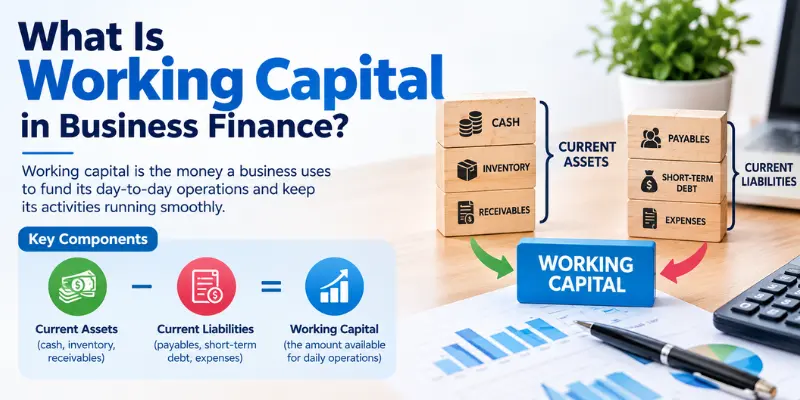
Working capital generally refers to the resources available to support a company’s short-term operations.
A basic calculation is:
Working Capital = Current Assets − Current Liabilities
Current assets can include cash, inventory, and accounts receivable. Current liabilities can include short-term obligations such as amounts owed to suppliers and other current liabilities.
Working capital matters because a profitable business can still experience cash pressure if money is tied up in inventory or unpaid customer invoices.
For example, a manufacturer may purchase raw materials, produce goods, sell them on credit, and receive customer payment several weeks later. The business still needs available funds during that period to pay suppliers, employees, rent, and other expenses.
The RBI’s guidance on working-capital requirements provides relevant regulatory information for businesses and lenders.
What Is Cash Flow Management in Business Finance?
Cash-flow management involves monitoring the money entering and leaving a business.
Cash inflows can include customer payments, loans, investments, asset sales, and other receipts. Cash outflows can include salaries, rent, supplier payments, taxes, loan repayments, equipment purchases, and other expenses.
A business needs sufficient available cash to meet financial obligations when they become due.
Consider a company that sells products worth $50,000 on credit during a month. The sale may increase revenue, but the company may not receive the $50,000 immediately. During that period, it still needs cash to pay suppliers, employees, rent, and other expenses.
Cash-flow forecasting can help management estimate future cash shortages or surpluses and plan financing requirements.
Businesses that use borrowing should also distinguish cash flow from accounting profit. A profitable company can experience temporary cash shortages when customer payments are delayed.
What Is Financial Planning in Business Finance?
Financial planning is the process of estimating future financial requirements and creating a plan for managing business resources.
A business financial plan may include expected revenue, operating costs, capital expenditure, working capital, financing requirements, debt repayments, cash reserves, and projected profitability.
Financial planning helps management evaluate whether the business can support a planned expansion, purchase new equipment, hire additional employees, or launch a new product.
A small business may prepare a monthly cash-flow forecast, while a large company may maintain detailed annual budgets, long-term financial models, and investment plans.
Financial planning also helps management compare expected performance with actual results and identify areas that require adjustment.
What Is Capital Budgeting?
Capital budgeting is the process of evaluating major long-term investments.
A business may use capital budgeting when deciding whether to purchase machinery, build a new facility, open another location, develop a major product, or invest in technology.
Management can estimate the initial investment, expected cash flows, operating costs, potential benefits, risks, and expected time horizon.
Common capital-budgeting techniques include net present value, internal rate of return, payback period, and profitability index.
Capital budgeting is important because large investments can commit substantial financial resources for several years.
What Is Business Financing?
Business financing refers to the process of obtaining money or capital for business activities.
A business may seek financing for:
Starting a business
Purchasing inventory
Buying equipment
Managing working capital
Hiring employees
Launching products
Expanding operations
Refinancing existing debt
Acquiring another company
Funding technology
Entering new markets
The financing structure should match the purpose and duration of the requirement. Short-term needs can require short-term financing, while major long-term investments may require longer-term capital.
The Ministry of MSME’s current lender guide distinguishes working-capital loans from term loans and explains common business uses for each. (Ministry of MSME)

What Is the Difference Between Business Finance and Corporate Finance?
Business finance and corporate finance are closely related.
Business finance is a broad term covering financial management and funding requirements across businesses of different sizes.
Corporate finance is generally associated with the financial decisions of corporations and larger companies. It commonly includes capital structure, capital budgeting, financing decisions, investment decisions, and working-capital management.
A small business owner may manage business finance by monitoring cash flow, expenses, inventory, loans, and business growth.
A large corporation may have dedicated finance departments handling treasury, capital structure, mergers and acquisitions, financial planning, investor relations, and capital-market activities.
The terms can overlap, but their organizational context and scope can differ.
What Are the Benefits of Effective Business Finance?
Effective business finance can support several areas of business management.
Better Cash Management
Monitoring cash inflows and outflows helps management identify upcoming funding requirements.
Improved Budget Control
Budgets provide a framework for comparing expected and actual income and expenses.
Better Funding Decisions
Financial analysis can help management evaluate whether to use retained earnings, debt, equity, or another financing source.
Support for Business Growth
A company may require additional capital to increase production, expand facilities, hire employees, or enter new markets.
Risk Management
Financial planning can help identify liquidity, credit, interest-rate, investment, and debt-related risks.
More Informed Investment Decisions
Financial projections can help management evaluate major business investments before committing capital.
What Financial Statements Are Used in Business Finance?
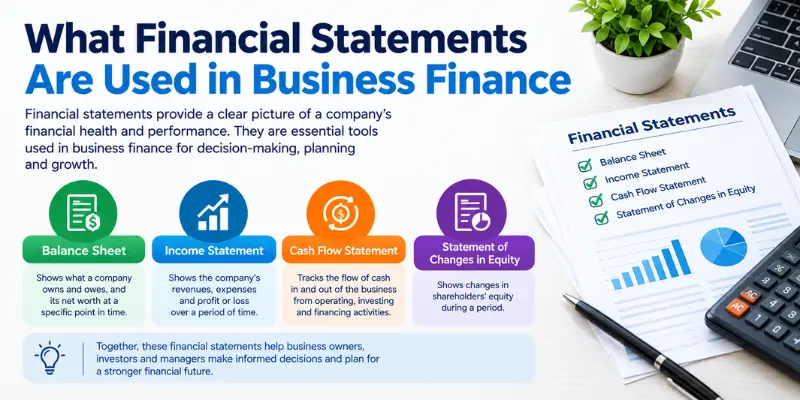
Financial statements provide important information for financial analysis and decision-making.
Income Statement
An income statement reports revenue, expenses, and profit or loss over a specified period.
Balance Sheet
A balance sheet presents assets, liabilities, and equity at a specific point in time.
Cash Flow Statement
A cash flow statement shows cash movements from operating, investing, and financing activities.
Management can use these statements to evaluate profitability, liquidity, financial position, cash generation, and financing needs.
Financial statements can also help lenders and investors assess a business before providing capital.
For businesses evaluating their overall financial position, these statements provide much of the information required for budgeting, forecasting, and financial analysis.
What Are Common Business Finance Ratios?
Financial ratios can help management and other stakeholders analyze a company’s financial condition.
Current Ratio
The current ratio compares current assets with current liabilities and provides an indication of short-term liquidity.
Quick Ratio
The quick ratio provides a more conservative liquidity measure by excluding certain less-liquid current assets.
Debt-to-Equity Ratio
This ratio compares debt with shareholders’ equity and provides information about the company’s financing structure.
Net Profit Margin
Net profit margin measures the proportion of revenue remaining as profit after relevant expenses.
Return on Equity
Return on equity measures profitability relative to shareholders’ equity.
Ratios should be interpreted in context. Industry characteristics, company size, accounting practices, business cycles, and historical performance can affect their meaning.
What Are the Main Risks in Business Finance?
Business finance involves several financial risks.
Liquidity Risk
A company may struggle to meet short-term obligations if available cash is insufficient.
Credit Risk
A customer or counterparty may fail to make a payment.
Interest-Rate Risk
Changes in interest rates can affect borrowing costs for businesses with variable-rate debt.
Market Risk
Changes in asset prices, exchange rates, commodity prices, or other market conditions can affect financial results.
Operational Risk
Business disruptions, technology failures, supply problems, fraud, or other operational events can create financial losses.
Debt Risk
Excessive borrowing can increase repayment obligations and place pressure on cash flow.
Financial risk management involves identifying relevant risks, measuring their potential effects, and establishing appropriate controls.
Business Finance Example
Consider a small manufacturing business that needs $100,000 to expand production.
The company estimates that it needs $40,000 for machinery, $30,000 for inventory, and $30,000 for additional working capital.
The owner reviews existing cash reserves and determines that $40,000 is available internally. The remaining $60,000 may require external financing.
The company then evaluates available financing options, expected interest costs, repayment requirements, cash-flow projections, and the expected financial benefits of expansion.
This example shows how business finance connects funding decisions with business operations and long-term planning.
Business Finance for Small Businesses
Small businesses often face financial challenges related to limited cash reserves, irregular revenue, customer payment delays, inventory requirements, and access to external financing.
A small business can strengthen its financial management by maintaining accurate financial records, monitoring cash flow, preparing budgets, controlling unnecessary expenses, reviewing receivables, and planning financing requirements before cash becomes critical.
The Ministry of MSME’s lender guidance provides information about different financing arrangements available to MSMEs.
For readers researching a specific finance company, our Shriram Finance guide covering loans, eligibility, interest rates, and EMI information provides a separate company-specific resource.
Business Finance vs Personal Finance
Business finance and personal finance both involve managing money, but their objectives and financial structures are different.
Personal finance focuses on an individual’s or household’s income, expenses, savings, debt, investments, insurance, and financial goals.
Business finance focuses on company revenue, expenses, cash flow, working capital, financing, investment, assets, liabilities, profitability, and business growth.
A business owner may use personal finance to manage household money while using business finance to manage company resources.
Keeping business and personal finances properly separated can also make accounting, reporting, budgeting, and financial analysis clearer.
Readers who want to understand the wider financial subject can explore our complete guide to finance and its major types.
Business Finance vs Accounting
Business finance and accounting work closely together but have different primary purposes.
Accounting focuses on recording, classifying, summarizing, and reporting financial transactions.
Business finance focuses on using financial information to make decisions about funding, investments, cash flow, capital allocation, budgeting, and financial planning.
For example, accounting records revenue and expenses. Business finance can use that information to determine whether the company has sufficient cash to expand or whether additional financing is required.
A strong accounting system gives financial managers reliable information for planning and decision-making.
How Can a Business Improve Its Financial Management?
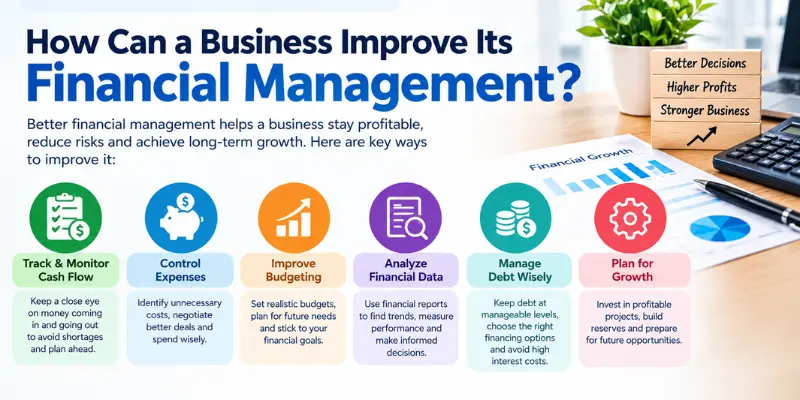
A business can improve financial management by establishing clear financial controls and regularly reviewing financial performance.
Management can create realistic budgets, monitor cash flow, track accounts receivable, control expenses, review debt obligations, maintain appropriate cash reserves, and compare actual results with forecasts.
Businesses can also establish financial targets for revenue, margins, operating expenses, working capital, debt, and cash reserves.
Regular financial reviews allow management to identify problems before they become larger financial issues.
Businesses should also review their financing arrangements periodically to determine whether existing debt, credit facilities, or other funding sources continue to meet their needs.
Frequently Asked Questions About Business Finance
What is business finance in simple words?
Business finance is the management of money and financial resources used to operate, fund, and grow a business.
Why is business finance important?
Business finance helps a company manage cash flow, expenses, working capital, financing, investments, debt, and financial risks.
What are the main types of business finance?
Major areas include working capital finance, short-term finance, long-term finance, equity finance, debt finance, and capital budgeting.
What is working capital finance?
Working capital finance provides funds for short-term operating requirements such as inventory, supplier payments, receivables, and other business expenses.
What are examples of business finance sources?
Examples include retained earnings, owner contributions, bank loans, business credit facilities, equity investment, venture capital, trade credit, and leasing.
What is the difference between business finance and corporate finance?
Business finance is a broad term covering financial management in businesses. Corporate finance generally focuses on financial decisions within corporations, particularly capital allocation, financing, investment, and capital structure.
Can small businesses use business finance?
Yes. Small businesses use business finance for working capital, inventory, equipment, payroll, expansion, technology, and other operating or investment requirements.
What is the role of cash flow in business finance?
Cash flow shows how money moves into and out of a business. Managing it helps a company meet financial obligations and plan future funding requirements.
Final Thoughts
Understanding what is business finance provides a foundation for understanding how companies manage money, obtain funding, control expenses, maintain working capital, evaluate investments, and support growth.
Business finance covers much more than business loans. It includes cash-flow management, budgeting, financial forecasting, working capital, capital budgeting, equity financing, debt financing, financial statements, risk management, and long-term financial planning.
A business can use internal resources or external financing depending on its financial position and objectives. The appropriate approach depends on the company’s size, industry, cash-flow requirements, financing costs, repayment capacity, ownership structure, and investment plans.
For Indian businesses, understanding working-capital requirements and available financing structures is relevant when evaluating business funding. RBI and the Ministry of MSME provide official resources covering business lending and working-capital finance.
Business finance ultimately connects financial resources with business decisions. A clear understanding of money, capital, cash flow, funding, risk, and financial planning can help business owners and managers evaluate their financial position and plan for sustainable operations.






- Be Respectful
- Stay Relevant
- Stay Positive
- True Feedback
- Encourage Discussion
- Avoid Spamming
- No Fake News
- Don't Copy-Paste
- No Personal Attacks
- Be Respectful
- Stay Relevant
- Stay Positive
- True Feedback
- Encourage Discussion
- Avoid Spamming
- No Fake News
- Don't Copy-Paste
- No Personal Attacks
