What Are Dividends? Meaning, Types, How They Work & Examples
Published: 24 Nov 2026
Introduction
Investing in the stock market can provide several opportunities to build wealth over time. One way investors may earn money from stocks is through dividends. However, many beginners do not fully understand what dividends are, why companies distribute them, or how shareholders receive these payments. Understanding dividends can help investors make more informed financial decisions and develop a better investment strategy.

So, what are dividends? Dividends are payments that a company distributes to its shareholders, usually from its profits or accumulated earnings. Companies commonly pay dividends in cash, although some distribute additional shares instead. These payments allow eligible investors to receive a portion of a company’s earnings without selling their shares.
For example, imagine that you own 100 shares of a company that declares a quarterly dividend of $0.50 per share. You would receive $50 before any applicable taxes, provided you qualify for the distribution.
However, not every company pays dividends. Some businesses prefer to reinvest their earnings into expansion, research, technology, or other growth opportunities. Therefore, understanding how dividend payments work, their different types, and their potential advantages and risks is important before investing.
If you are new to financial markets, our guide on what is the stock market and how it works provides useful background about shares, shareholders, and stock ownership. Similarly, learning what investment means and how it works can help you understand how dividends fit into a broader financial strategy.
This guide explains what dividends are, how companies distribute them, important dividend dates, dividend yield, taxation, and how investors can evaluate dividend-paying stocks in the United States.
What Are Dividends?
Dividends are portions of a company’s earnings or accumulated profits distributed to eligible shareholders. When someone purchases shares of a dividend-paying company, they become a shareholder and may receive a portion of these payments, depending on the company’s dividend policy and applicable eligibility dates.
A company’s board of directors generally decides whether to declare a dividend, how much to distribute, and when shareholders will receive the payment. Companies commonly distribute dividends every three months, although some pay them monthly, semiannually, or annually.
For instance, if a company declares a dividend of $1 per share and you own 200 eligible shares, your payment would be $200. The amount depends on the dividend declared per share and the number of eligible shares you own.
Dividends are commonly associated with established businesses that generate relatively consistent cash flows. Banks, utility companies, consumer goods businesses, and some industrial companies are examples of industries where dividend-paying stocks can be found.
Nevertheless, dividends are not guaranteed. A company can reduce, suspend, or completely eliminate its dividend if its financial circumstances change.
It is also important to understand that receiving dividends does not automatically mean that an investment is profitable. A stock’s market price can decline, potentially offsetting some or all of the income received from dividend payments.
According to Investor.gov’s explanation of dividends, dividends represent a portion of a company’s profit paid to shareholders. This basic definition provides a useful starting point for understanding how businesses distribute earnings.
How Do Dividends Work?
Dividend payments follow a process that begins when a company’s board of directors approves a distribution. The company then announces the payment amount and relevant dates so investors know who qualifies to receive the dividend and when the money will be distributed.
Understanding this process is particularly useful for beginners because purchasing shares shortly before a payment does not always guarantee eligibility.
Generally, dividend payments work through the following steps.
1. A Company Earns Profits or Accumulates Retained Earnings
A business generates revenue through its products and services. After paying operating expenses, taxes, interest, and other costs, it may retain some earnings. The company can use these funds for expansion, debt reduction, reserves, or shareholder distributions.
2. The Board of Directors Declares a Dividend
When a company decides to distribute money to shareholders, its board approves the dividend amount and announces the important dates. For example, a company might declare a quarterly dividend of $0.40 per share.
3. Investors Must Qualify for the Dividend
Shareholders generally need to purchase shares before the ex-dividend date to qualify for the upcoming payment. The ex-dividend date determines whether a newly purchasing investor receives the declared dividend.
4. The Company Distributes the Payment
On the payment date, the company sends the dividend to eligible shareholders. Investors holding shares through a brokerage account generally receive the payment through that account.
5. Investors Can Use or Reinvest the Money
Shareholders may keep the cash, use it for personal expenses, or reinvest it by purchasing additional shares. Some brokerage firms also offer dividend reinvestment plans, commonly called DRIPs.
For example, suppose you own 150 shares of a company that declares a quarterly dividend of $0.60 per share.
Your dividend calculation would be:
- Shares owned: 150
- Dividend per share: $0.60
- Total dividend: $90
You would receive $90 before applicable taxes, assuming all 150 shares qualify for the distribution.
This example demonstrates why the number of eligible shares and the declared dividend amount are important when calculating dividend income.
Why Do Companies Pay Dividends?
Companies distribute dividends for several business and financial reasons. One important purpose is to share a portion of their earnings with shareholders who have invested capital in the business.
A company with established operations and consistent cash generation may not need to reinvest every dollar it earns. Therefore, its board may decide that distributing some available earnings is an appropriate way to reward shareholders.
There are several common reasons companies pay dividends.
Rewarding Shareholders: Investors provide capital by purchasing company shares. Dividends allow businesses to distribute some earnings to eligible shareholders and potentially strengthen long-term investor relationships.
Attracting Income-Focused Investors: Some investors prefer companies that provide recurring dividend payments. A consistent distribution policy may make a business attractive to individuals seeking investment income.
Demonstrating Financial Confidence: A company that regularly pays dividends may communicate confidence in its financial position and future cash-generating ability. However, a dividend announcement alone does not prove that a business is financially strong.
Returning Excess Cash: Some mature businesses generate more cash than they currently need for expansion. Instead of retaining all available funds, their boards may choose to distribute a portion to shareholders.
Maintaining a Dividend Policy: Certain companies aim to maintain or gradually increase their dividend payments over time. Such policies may appeal to investors who value a history of shareholder distributions.
However, paying dividends is a business decision rather than a requirement for every company. Businesses experiencing rapid growth may prefer to retain earnings and invest in new opportunities.
What Are the Different Types of Dividends?
Companies can distribute dividends in several ways. The type depends on the company’s financial position, distribution policy, and decision by its board of directors. Some dividends provide shareholders with cash, while others increase the number of shares they own.
Understanding these categories can help investors identify how companies reward shareholders and what each distribution means for their investments.
1. Cash Dividends
Cash dividends are the most common type of dividend. Companies distribute money directly to eligible shareholders, usually through brokerage accounts or other approved payment methods.
For example, suppose you own 250 shares of a company that declares a cash dividend of $0.80 per share. Your total payment would be:
250 × $0.80 = $200
Cash dividends can provide shareholders with an additional source of income. Investors may use this money for everyday expenses, savings, retirement needs, or purchasing additional investments.
However, companies are not legally required to maintain the same dividend payment forever. Their boards may change the distribution depending on business performance and financial priorities.
2. Stock Dividends
Stock dividends are distributions in which a company provides additional shares instead of cash. These payments increase the number of shares an investor owns without requiring an additional purchase.
For example, imagine that you own 100 shares of a company that announces a 10% stock dividend. You would receive 10 additional shares, increasing your total ownership to 110 shares.
Although stock dividends increase the number of shares, they do not automatically increase the overall market value of your investment. The share price may adjust to reflect the additional shares in circulation.
Companies may use stock dividends when they want to reward shareholders while preserving cash for business operations and future expansion.
3. Special Dividends
Special dividends are additional payments that companies distribute outside their regular dividend schedules. They are often declared when a business has excess cash, receives significant proceeds from an asset sale, or experiences an unusually strong financial period.
For example, a company that normally pays $0.40 per share quarterly might announce an additional one-time payment of $1.50 per share.
Unlike regular dividends, special dividends are not necessarily repeated. Investors should not assume that an exceptional payment will become part of the company’s normal distribution policy.
4. Preferred Dividends
Preferred dividends are payments made to holders of preferred stock. Preferred shareholders generally receive dividend priority over common shareholders, although the specific rights depend on the company’s preferred-stock terms.
Some preferred stocks carry a fixed dividend rate, meaning the payment is determined according to the stated terms rather than changing directly with the company’s ordinary earnings.
For example, if a preferred share has a stated annual dividend of $5, an investor holding 100 such shares would generally be entitled to $500 in annual dividends, subject to the security’s terms and the company’s ability to make payments.
Preferred shareholders usually have fewer voting rights than common shareholders. However, their priority in dividend distributions can make preferred stock attractive to investors seeking a different income and risk profile.
5. Property Dividends
Property dividends are distributions made through assets other than cash or additional shares of the distributing company. Depending on the circumstances, a company may distribute securities, physical assets, or other property to its shareholders.
These distributions are less common than cash dividends. Their value and tax treatment can depend on the type of property distributed and applicable tax rules.
6. Liquidating Dividends
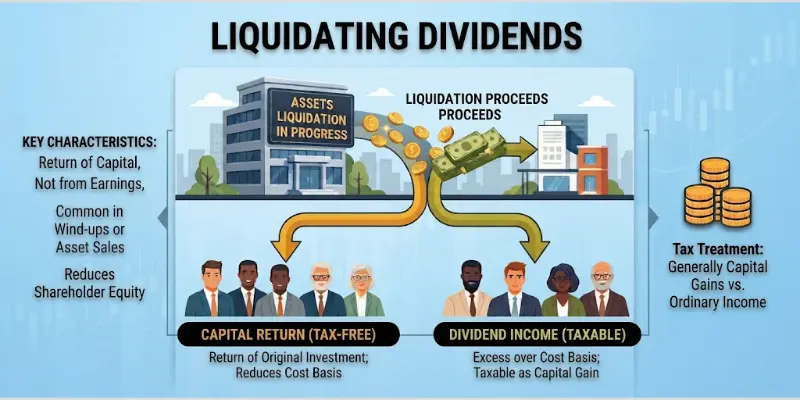
Liquidating dividends occur when a company returns part of its capital to shareholders during a liquidation or business closure. Unlike regular dividends, which are generally associated with earnings and profits, liquidating distributions represent a return of investment capital.
For example, a business that sells its assets and begins closing operations may distribute some remaining funds to shareholders after addressing its obligations.
These payments should not be confused with ordinary dividend income because their legal and tax treatment can be different.
How Often Do Companies Pay Dividends?
Companies can follow different dividend payment schedules depending on their policies, earnings, cash flow, and shareholder distribution plans. In the United States, quarterly payments are particularly common among established dividend-paying corporations.
However, there is no universal schedule that every company must follow. Some businesses distribute dividends monthly, while others make payments annually or semiannually.
The following are common dividend payment frequencies.
- Monthly dividends: Some companies and investment funds distribute payments every month. This schedule may appeal to investors who prefer more frequent income.
- Quarterly dividends: Companies distribute payments four times a year, usually at three-month intervals. This is a common arrangement among US corporations.
- Semiannual dividends: Companies distribute dividends twice a year, often every six months.
- Annual dividends: Some businesses make one dividend payment each year.
- Special dividends: These are occasional distributions that do not follow a regular schedule.
For example, suppose a company declares a quarterly dividend of $0.50 per share. An investor holding 200 shares could receive $100 every quarter if the company maintains that distribution and the investor qualifies for each payment.
Over four quarters, the total would be $400 before applicable taxes.
Investors should remember that past payment schedules do not guarantee future distributions. Companies can change their dividend policies whenever their boards determine that a change is appropriate.
What Are the Four Important Dividend Dates?
Understanding dividend dates is essential for anyone interested in receiving dividend payments. Companies announce several dates when declaring a distribution. Each date has a specific purpose and determines when investors qualify for the payment.
The four important dividend dates are the declaration date, ex-dividend date, record date, and payment date.
1. Declaration Date
The declaration date is when a company’s board of directors officially announces a dividend. The announcement generally includes the payment amount, ex-dividend date, record date, and payment date.
For example, a company might announce that it will distribute $0.75 per share to eligible shareholders.
This announcement allows investors to understand the upcoming payment and review the company’s distribution policy.
2. Ex-Dividend Date
The ex-dividend date is the date on or after which a newly purchasing investor is generally no longer entitled to receive the upcoming dividend.
For most regular US stock dividends under the current T+1 settlement system, the ex-dividend date is generally the same as the record date when the record date is a business day. If the record date falls on a non-business day, exchange rules determine the applicable ex-dividend date.
Investors who purchase shares before the ex-dividend date generally qualify for the upcoming payment. Those purchasing on or after that date generally do not.
This date is particularly important because buying a stock on the payment date or record date does not necessarily qualify an investor for the declared distribution.
3. Record Date
The record date is the date when the company checks its shareholder records to determine which investors are entitled to receive the dividend.
Investors who qualify according to the applicable ex-dividend rules are included in the distribution.
For example, if a company sets a business day as its record date and the ex-dividend date is the same day, an investor generally needs to purchase the shares before that date to qualify.
4. Payment Date
The payment date is when the company distributes the dividend to eligible shareholders.
Investors holding shares through a brokerage account generally receive their cash payments directly in that account. Depending on the brokerage firm’s procedures, the money may appear as available cash or be automatically reinvested if a dividend reinvestment plan is active.
The SEC’s Investor.gov guide to ex-dividend dates provides additional explanations and examples of how these dates work. Investors can also review the SEC’s information about the T+1 securities settlement cycle to understand the settlement system used for most US securities transactions.
What Is Dividend Yield?
Dividend yield is a financial measurement that shows how much annual dividend income a company pays relative to its current stock price. Investors use this percentage to compare the income potential of different dividend-paying stocks.
It is particularly useful when evaluating companies with different share prices and dividend amounts.
The dividend yield formula is:
Dividend Yield = (Annual Dividend Per Share ÷ Current Share Price) × 100
For example, imagine that a company has a current share price of $50 and pays an annual dividend of $2 per share.
The calculation would be:
($2 ÷ $50) × 100 = 4%
Therefore, the company’s dividend yield is 4%.
This means that an investor purchasing shares at $50 would receive an annual dividend equivalent to 4% of the purchase price, assuming the dividend remains unchanged.
However, dividend yield is not a guaranteed investment return. The stock price can change, and the company may reduce or eliminate its dividend.
A particularly high dividend yield can sometimes indicate financial difficulties or a significant decline in the company’s share price. Therefore, investors should examine the company’s earnings, debt, cash flow, and dividend history rather than choosing stocks based only on yield.
For a broader understanding of how different financial assets generate returns, readers can also explore our guide on what investment means and the different investment options available.

What Is Dividend Payout Ratio?
The dividend payout ratio measures the percentage of a company’s earnings distributed to shareholders as dividends. It helps investors understand how much profit a business distributes and how much it retains for future activities.
The basic formula is:
Dividend Payout Ratio = (Dividends Per Share ÷ Earnings Per Share) × 100
For example, suppose a company earns $5 per share and distributes $2 per share as dividends.
Its payout ratio would be:
($2 ÷ $5) × 100 = 40%
This means the company distributes 40% of its earnings and retains the remaining 60%, assuming the figures are calculated on a comparable basis.
A moderate payout ratio may indicate that a company balances shareholder distributions with business investment. However, an appropriate ratio varies across industries and business models.
A very high payout ratio may suggest that a company has limited room to increase dividends or could face difficulties maintaining payments if earnings decline.
Investors should also remember that earnings can sometimes be affected by unusual accounting items. For this reason, comparing dividends with free cash flow can provide additional insight into a company’s ability to fund its distributions.
What Is the Difference Between Cash Dividends and Stock Dividends?
Cash dividends and stock dividends are two common ways companies distribute value to shareholders. Although both reward investors, their payment methods and potential effects are different.
| Feature | Cash Dividends | Stock Dividends |
|---|---|---|
| Payment method | Cash | Additional shares |
| Income received | Money | More company shares |
| Share ownership | Usually unchanged | Number of shares increases |
| Cash available to company | Reduced | Generally preserved |
| Immediate cash income | Yes | No |
| Tax treatment | Depends on classification | Depends on distribution structure |
For example, an investor holding 100 shares of a company may receive $100 through a cash dividend or 10 additional shares through a 10% stock dividend.
The cash dividend provides money that can be used immediately. The stock dividend increases the number of shares owned but does not necessarily increase the total investment value.
Neither method automatically makes an investment more profitable. Investors should evaluate the company’s financial position and the economic effect of the distribution.
Are Dividends Taxable in the United States?
Dividends can be taxable income for investors in the United States. However, the amount of tax an individual pays depends on the type of dividend, income level, holding period, and applicable federal tax rules.
The Internal Revenue Service generally classifies taxable dividends into ordinary dividends and qualified dividends. These categories have different tax treatments.
1. Ordinary Dividends
Ordinary dividends are distributions generally paid from a company’s earnings and profits. They are typically taxed as ordinary income according to the investor’s applicable federal income tax bracket.
For example, if an investor receives $500 in ordinary dividends during a tax year, that amount is generally included in taxable income.
Ordinary dividends are usually reported in Box 1a of Form 1099-DIV.
2. Qualified Dividends
Qualified dividends are a category of ordinary dividends that may qualify for lower federal tax rates. Depending on the investor’s taxable income and filing status, these dividends may be taxed at 0%, 15%, or 20% under applicable federal rules.
However, not every dividend qualifies. Investors generally need to meet specific requirements relating to the paying corporation and the period they hold the shares.
For common stock, the general holding-period requirement is more than 60 days during the 121-day period beginning 60 days before the ex-dividend date.
3. Reporting Dividend Income
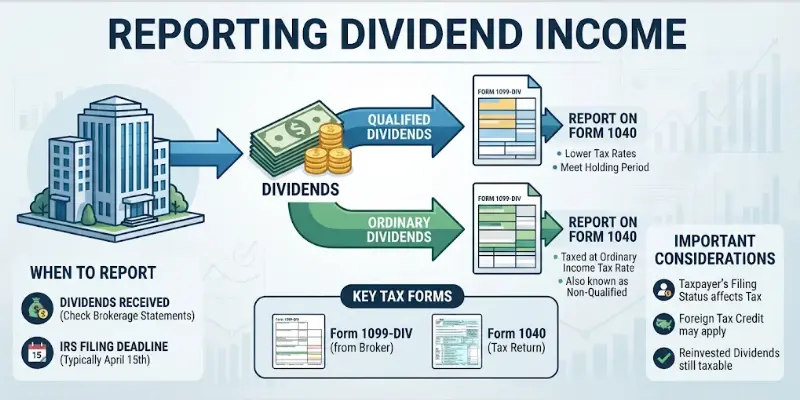
Brokerage firms and other financial institutions generally provide Form 1099-DIV to report dividends and certain other distributions. Investors use this information when preparing their federal income tax returns.
Even if an investor does not receive Form 1099-DIV, taxable dividend income may still need to be reported.
For example, ordinary dividends generally appear on Form 1040, while qualified dividends are separately identified for the applicable tax calculation.
Investors should also understand that certain investment distributions, including some REIT and mutual fund distributions, may have different tax classifications.
For accurate information, visit the official IRS guidance on dividends and corporate distributions and Publication 550: Investment Income and Expenses. Tax rules can change, so investors should review the guidance for the relevant tax year or consult a qualified tax professional.
Advantages and Disadvantages of Dividends
Dividend-paying stocks can offer several potential benefits, particularly for investors who want to receive income while maintaining ownership of company shares. However, these investments also involve risks that should be considered before making a financial decision.
Understanding both sides can help investors decide whether dividend stocks are appropriate for their investment objectives.
Advantages of Dividends
1. Potential Regular Income
One of the main advantages of dividends is that they can provide recurring income. Companies with established dividend policies may distribute payments quarterly or according to another regular schedule.
Investors may use these payments to cover expenses, supplement retirement income, or support other financial goals.
However, regular payments are not guaranteed, and companies can change their distribution policies.
2. Opportunity to Reinvest Earnings
Investors who do not need immediate cash income can reinvest their dividends into additional shares.
Over time, reinvesting dividends may increase the number of shares held and potentially increase future dividend income if the company maintains or increases its distributions.
This approach can contribute to compounding, although investment returns and dividend payments remain uncertain.
3. Potential Indicator of Financial Strength
A consistent dividend history may indicate that a company has generated sufficient cash flow to distribute money to shareholders over time.
However, dividend payments alone do not prove that a business is financially healthy. Investors should also examine profitability, debt levels, cash flow, and future business prospects.
4. Portfolio Income Diversification
Dividend-paying stocks can provide an additional source of investment income alongside other assets. Investors may combine dividend stocks with growth stocks, bonds, and other investments according to their financial goals and risk tolerance.
Diversification can help reduce dependence on a single investment, although it cannot eliminate market risk.
Disadvantages of Dividends
1. Dividend Payments Are Not Guaranteed
Companies can reduce, suspend, or eliminate dividends when financial conditions become difficult.
A business facing declining revenue, increasing debt, or cash-flow problems may decide to preserve its money rather than distribute it to shareholders.
Therefore, investors should never assume that a company will continue paying the same dividend indefinitely.
2. Share Prices Can Decline
Receiving dividends does not protect an investor from falling stock prices.
For example, if someone purchases shares for $100 and receives $4 in annual dividends, but the stock price declines to $85, the market value of the investment has fallen significantly.
Dividend income should therefore be evaluated alongside total investment performance.
3. Tax Obligations
Dividend income may create federal and state tax obligations, depending on the investor’s circumstances and applicable rules.
Even when dividends are reinvested automatically, taxable dividend income may still need to be reported.
4. High Dividend Yields Can Be Risky
Some companies show unusually high dividend yields because their share prices have declined sharply.
This situation may indicate that investors are concerned about the company’s financial health or the sustainability of its payments.
A high yield should not automatically be considered a good investment opportunity.
How to Evaluate Dividend-Paying Stocks
Choosing dividend-paying stocks requires more than comparing their advertised yields. Investors should examine the company’s financial condition, distribution history, and ability to maintain future payments.
A company that offers a high dividend today may not necessarily provide reliable income over the long term.
The following factors can help investors evaluate dividend stocks.
1. Examine Dividend History
Review how consistently the company has distributed dividends over several years. Check whether payments have remained stable, increased, or declined.
A long history of payments can provide useful information, but past performance does not guarantee future distributions.
2. Check Dividend Yield
Compare the company’s dividend yield with other businesses in the same industry.
For example, a 4% dividend yield may appear attractive, but investors should investigate why the company offers that percentage and whether its earnings can support the payments.
Avoid selecting a stock based only on the highest available yield.
3. Review the Payout Ratio
The dividend payout ratio helps determine how much of a company’s earnings are distributed to shareholders.
A company that distributes nearly all its earnings may have less flexibility to finance expansion, reduce debt, or maintain dividends during difficult economic periods.
However, payout ratios should be compared with businesses operating in similar industries because appropriate levels vary.
4. Analyze Cash Flow
Cash flow is particularly important because companies need available cash to fund distributions and business operations.
Investors should examine operating cash flow and free cash flow to understand whether the business can comfortably support its dividend policy.
A company reporting accounting profits but experiencing weak cash flow may face difficulties maintaining distributions.
5. Understand the Company’s Debt
High debt levels can place pressure on a company’s finances, especially when borrowing costs increase.
Investors should review debt obligations, interest expenses, and the company’s ability to generate sufficient cash to meet its financial commitments.
6. Consider Business Stability
A company operating in an established industry with predictable demand may have a different dividend profile from a young business experiencing rapid growth.
However, even established companies can face competition, regulatory changes, technological disruption, and economic uncertainty.
Investors should understand the business model before relying on its dividend payments.
What Is Dividend Reinvestment?
Dividend reinvestment means using dividend payments to purchase additional shares instead of receiving or keeping the money as cash.
Many brokerage firms provide dividend reinvestment plans, commonly known as DRIPs. These plans allow eligible investors to automatically reinvest dividends into additional shares of the same company or investment.
For example, imagine that you own 100 shares of a company and receive $100 in dividends. Instead of withdrawing the payment, you use it to purchase additional shares.
If the stock is trading at $50, the dividend could purchase two additional shares before any applicable fees or fractional-share arrangements.
You would then own 102 shares.
If the company continues paying dividends, those additional shares may also qualify for future distributions, provided you meet the applicable requirements.
This process can create a compounding effect over time.
However, dividend reinvestment does not eliminate investment risk. The share price can decline, and the company can reduce or stop its dividend. Reinvested dividends may also remain taxable in a taxable brokerage account.
Investors should review their brokerage firm’s reinvestment terms, fees, and tax reporting procedures before enrolling.
Can Companies Stop Paying Dividends?
Yes. Companies can reduce, suspend, or eliminate dividend payments when their financial circumstances or business priorities change.
A dividend declaration is not a permanent promise that the company will continue making identical payments in the future.
Several situations may lead a company to change its dividend policy.
- Declining profits: A business experiencing lower earnings may decide to reduce distributions to preserve financial resources.
- Cash-flow problems: Companies need sufficient cash to meet operating expenses, debt payments, and other obligations.
- Business expansion: A company may retain more earnings to finance new projects, equipment, technology, or market expansion.
- Economic uncertainty: Recessions, inflation, or industry challenges may encourage businesses to protect their financial position.
- Debt reduction: Some companies prioritize paying down borrowing rather than distributing money to shareholders.
For example, a company that previously paid $1 per share annually may reduce its distribution to $0.50 if its earnings and cash flow weaken.
Investors who depend heavily on dividend income should monitor company announcements and financial statements rather than assuming that previous payment levels will continue.
Are Dividend Stocks Suitable for Beginners?
Dividend stocks can be suitable for beginners who want to understand how stock market investments may generate income. However, new investors should learn the basics before purchasing shares.
A beginner should first understand the company’s business, dividend policy, financial performance, and potential risks.
For example, someone investing for long-term growth may prefer companies that reinvest most of their earnings. Another investor seeking regular income may consider established dividend-paying businesses.
There is no single approach that works for everyone. The right choice depends on investment goals, time horizon, financial circumstances, and risk tolerance.
Beginners should also avoid investing all their money in one dividend-paying company. Holding investments across different companies and industries can help reduce exposure to individual business problems.
Most importantly, dividends should be considered one part of an investment strategy rather than a guaranteed source of income.
Readers who want to understand the broader relationship between financial assets, returns, and risk can also refer to our guide on investment and its different types.
Frequently Asked Questions About Dividends
1. What are dividends in simple terms?
Dividends are payments that companies distribute to eligible shareholders, usually from earnings or accumulated profits. They are commonly paid in cash, although companies may distribute additional shares or other property.
2. How do dividends make money for investors?
Investors receive dividend payments when companies distribute money to shareholders. They can keep the payments as cash or reinvest them into additional shares. However, dividends do not guarantee an overall investment profit because stock prices can decline.
3. How often are dividends paid?
Many US companies pay dividends quarterly, meaning four times a year. Others distribute payments monthly, semiannually, or annually. The schedule depends on the company’s dividend policy.
4. Do all companies pay dividends?
No. Many companies do not distribute dividends because they prefer to reinvest earnings into business expansion, research, technology, or debt reduction. Dividend payments depend on company policy and board approval.
5. Are dividends taxable in the United States?
Yes, taxable dividends generally need to be reported to the IRS. Ordinary dividends are generally taxed as ordinary income, while qualified dividends may receive lower federal tax rates if eligibility requirements are met.
6. What is a good dividend yield?
There is no universally ideal dividend yield. Investors should compare yields across similar businesses and examine earnings, cash flow, debt, and dividend sustainability. An unusually high yield can sometimes indicate financial difficulties.
7. Can I receive dividends if I sell my shares?
You may still receive a declared dividend if you sell your shares on or after the ex-dividend date, provided you qualified for the payment. Selling before the ex-dividend date generally means the buyer becomes entitled to the upcoming dividend.
8. What is the difference between dividends and capital gains?
Dividends are distributions paid to shareholders by a company, whereas capital gains occur when an investor sells an investment for more than its purchase cost. Both can contribute to investment returns, but they are different sources of potential earnings.
9. Can dividends provide passive income?
Dividend-paying stocks can provide recurring investment income without requiring investors to sell their shares for each payment. However, dividends are not guaranteed, and investors still face market and company-specific risks.
10. What happens when a company cuts its dividend?

When a company reduces its dividend, shareholders receive less income than previously expected. A dividend reduction can also affect investor confidence and may influence the stock price, although the actual market reaction depends on the circumstances.
Conclusion
Understanding what dividends are is an important step for anyone learning about stock market investing. Dividends allow companies to distribute a portion of their earnings or other assets to eligible shareholders, providing investors with a potential source of income alongside possible stock price appreciation.
However, dividend payments are not guaranteed, and their value depends on the company’s financial performance, distribution policy, and market conditions. Investors should understand different dividend types, important payment dates, dividend yield, payout ratios, and applicable tax rules before making investment decisions.
For beginners, evaluating a company’s financial strength and dividend sustainability is generally more important than simply selecting stocks with the highest yields. Reinvesting dividends may also help increase share ownership over time, although investment risks remain.
Ultimately, dividends can play a useful role in a diversified investment strategy when selected according to individual financial goals and risk tolerance. Learning the fundamentals of stock market investing and understanding different investment options can provide a stronger foundation for making informed financial decisions.
Disclaimer: This article is for educational and informational purposes only. It does not constitute personalised financial, investment, or tax advice. Investment products involve risks, and readers should review official product documents and consult a qualified financial professional before making investment decisions.






- Be Respectful
- Stay Relevant
- Stay Positive
- True Feedback
- Encourage Discussion
- Avoid Spamming
- No Fake News
- Don't Copy-Paste
- No Personal Attacks
- Be Respectful
- Stay Relevant
- Stay Positive
- True Feedback
- Encourage Discussion
- Avoid Spamming
- No Fake News
- Don't Copy-Paste
- No Personal Attacks
